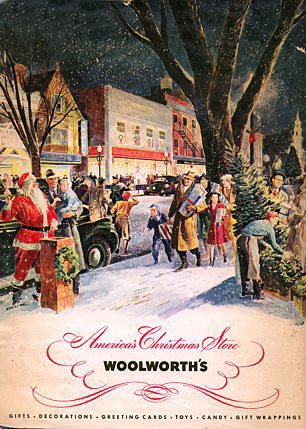
Welcome to the Original Virtual Museum - celebrating Woolworths' century at the heart of British High Street Shopping
 -  -  -  -  -
please click a menu button
please click a menu button Original Virtual Museum Home Page please click a menu button The Woolworth value store concept is born in the USA please click a menu button Laying the foundations as the first British Woolworth store opens in Liverpool in November 1909 please click a menu button Woolworths rapidly open forty-four stores in Britain and Ireland before facing a World War please click a menu button Bigger, brighter and bolder Woolworth stores in the Roaring Twenties please click a menu button Woolworths go to amazing lengths to keep all prices under sixpence in the Thirties please click a menu button Bravery and defiance during World War II in Woolworths' finest hour. We pay tribute to the sacrifices made and look behind the scenes please click a menu button Redefining the Woolworth brand for modern times in the 1950s, as prices go up and stores get bigger and bigger please click a menu button Superstores in and out of town, a new own brand and the opening of overseas Commonwealth stores during the 1960s please click a menu button Woolworth struggles to keep up during the rapid inflation and change of the 1970s please click a menu button Woolworth stores in more recent times, covering the period 1980-2008 please click a menu button
please click a menu button please click a menu button please click a menu button please click a menu button please click a menu button please click a menu button please click a menu button please click a menu button please click a menu button please click a menu button please click a menu button
Background to the Original Virtual Museum and copyright information about the contents Origins of the firm's legendary pic'n'mix and a century of chocolate, candy and confectionery in the High Street A century of music and entertainment in the High Street from sheet music and gramophone records to CDs and blu-ray discs A century of toys, games and fun in the High Street stores of F. W. Woolworth A century of fashion in the High Street, from paper patterns and sixpenny knickers to an extensive range of award-winning Ladybird clothing A century of cards, pens, pads and books from the shelves of F. W. Woolworth stores Pots and pans, paint and brushes, bulbs and compost and even toiletries - all in High Street Woolworth stores for much of the twentieth century Woolworths pioneered Christmas decorations in the 19th century and supplied presents for our parents, grandparents and great grandparents from their High Street stores Working conditions and pay rates at Woolworths over a hundred years and some of the people behind the brand-name Our cinema, quiz and picture gallery features Visit the new look 21st century Woolworths on line, on the site operated by Shop Direct Group
please click a menu button please click a menu button please click a menu button please click a menu button please click a menu button please click a menu button please click a menu button please click a menu button please click a menu button please click a menu button please click a menu button
 

Woolies' first catalogues in the 1930s and 1940

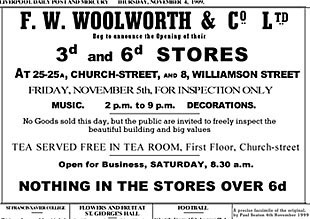
Opening advertisement from the Liverpool Daily Post & Mercury. (Our thanks to: Liverpool Evening Post)

In its early years the company rarely advertised. Occasionally handbills were produced to support a store opening and there were rare press advertisements to support big product launches like Gold Rings, Woolco Cotton and Lorraine Hairnets. But that was the limit. The founder, Frank Winfield Woolworth, summed it up like this: "Dress your windows twice a week with big leaders with prices attached. This is our advertising."

By the 1930s most Woolworth stores were typically two or three times larger than the originals. The range had become increasingly diverse, making it harder to keep customers aware of what was available. At the same time sales of magazines like Picturegoer were at an all-time high and had inspired a new style of "window-shopping" at home.

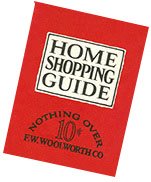
The American parent took the plunge with a pocket-sized "Home Shopping Guide" as part of celebrations of their 50th anniversary in 1929. It showed what ranges were stocked rather than giving details of specific products, and no prices were shown beyond the catch-all slogan "Nothing over 10 cents". It was a big hit and many customers kept the little booklet for reference about what products were available from the Five and Ten. In Britain, Woolworth started to advertise occasionally after going public in 1931. Most examples ostensibly announced a new opening while also promoting the brand and the breadth of range available in-store. The first full-page advertisement appeared in the London edition of the Daily Mail in 1932.
The Woolworth Home Shopping Guide (effectively a product list) was given away to customers along with the 50th Anniversary booklet.
 
F.W. Woolworth Advertisement from the London Edition of the Daily Mail in 1932. Click the image to open the full advertisement in a new window
Staff started to encounter customers holding the advertisements and asking for one of the featured items, or if they carried one of the more exotic 'larger stores only' departments. New sixpenny help brochures with advice as diverse as how to wire a plug and how to care for a canary sold well. This persuaded the firm that a general 'how to' catalogue might do well. In 1938 they launched Good Things To Know.
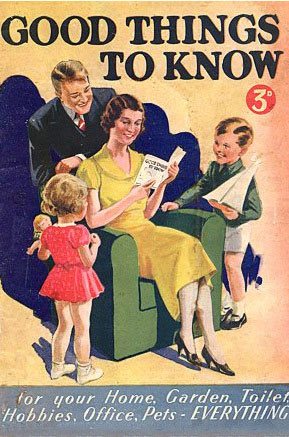
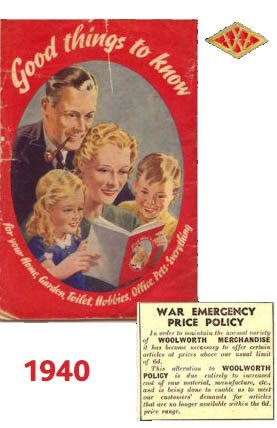
Good Things to Know - F. W. Woolworth & Co. Ltd.'s first catalogue. More than a million copies were sold in 1938 and 1939 for threepence (1½p) each

The new compact pamphlet was threepence. It included tips and tricks for the home and money-saving ideas. Beside each feature were supplier-funded adverts for items that could help do the job easily. Good Things To Know was marketed as a "miniature encyclopedia".

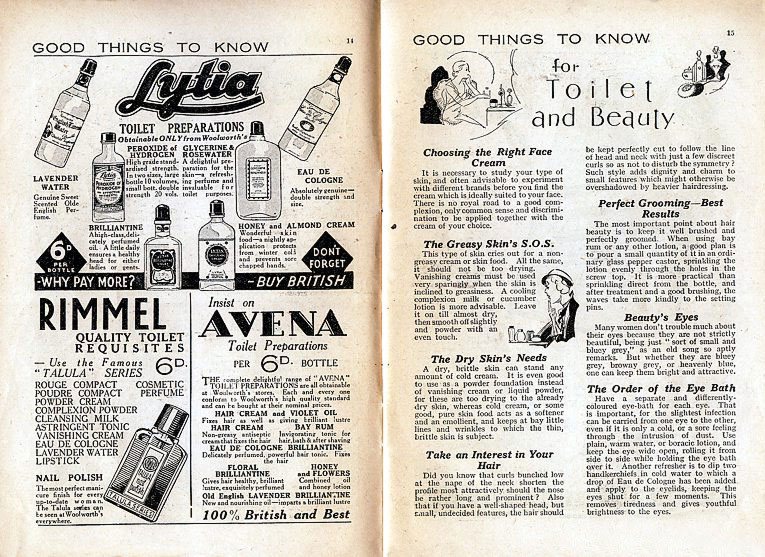
This was a very clever mix and proved popular with customers. There were tips for the kitchen, bathroom and garden as well as recipes, quizzes and beauty tips - all intermingled with details of the store range.

The booklet soon made good on its promise to deliver a guaranteed readership of a million.
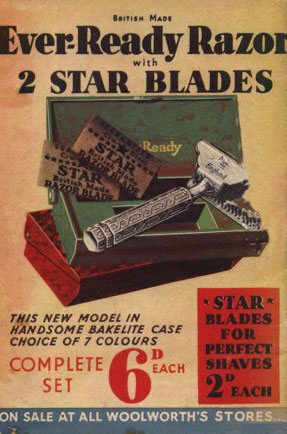
The back cover of the first F. W. Woolworth & Co. Ltd. Good Things To Know compact catalogue features an advertisement for an Ever Ready Razor with two star blades, all for sixpence
A sample spread from the first Good Things to Know booklet, which illustrates the mix of advertising and editorial. A number of advertisements from this booklet appear in the product galleries here in the Woolworths Virtual Museum
         
The second edition of Good Things to Know was altogether more austere, reflecting the difficult circumstances in the UK after the Battle of Britain. The booklet explains the temporary suspension of the Company's upper price limit of sixpence. This never came back.

In 1940 the second Good Things to Know focused on "make do and mend" with tips on how to repair old clothes, make meals go further and hang curtains to black out windows. Britain was at war with Germany.

America remained neutral. The economy was buoyant. Woolworth responded with its first full catalogue. The forty colour pages featured many gifts and treats, as well as practical items. The designers excelled, creating a ground-breaking, modern look which set the standard for others to follow.

The first Christmas catalogue produced by the American Woolworths, which dates from November 1940. The upbeat homely style seems a million miles away from the austerity of Britain in the Blitz
         
The British magazine (illustrated above and below on the left) was printed on low grade paper. Only the cover was in colour. It showcased Ezeglide Curtain Rail as a solution for blackout curtains and had charts to help people recognise Allied and Axis planes flying overhead. In North America, the full richly illustrated magazine (above and below on the right) carried the theme "Let Christmas be merry and bright ... for all". It suggested ways to brighten the home with candles and decorations from the five-and-ten. A further contrast was that, while most British items cost sixpence (2½p) or less, by 1940 a number of US prices had reached a dollar, roughly ten times more.
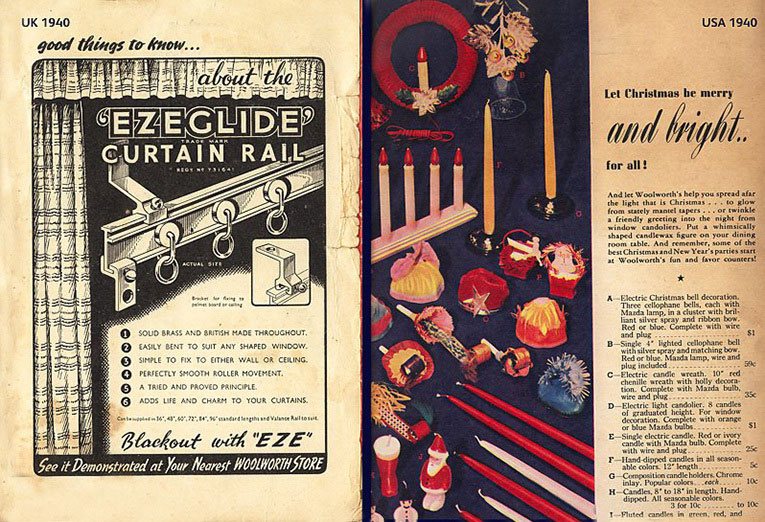
         
3,000 miles apart - but it could be a million miles. Christmas Catalogues from F. W. Woolworth UK on the left, offering blackout curtains for the Blitz and from the same company in the USA showing how to make Christmas merry and bright for all with candles and decorations


Quick Links to other exhibits in the Original Virtual Museum

1930s openings   Stock Market Flotation   Buying ingenuity   Working in a 30s store   Woolies' first character items   

Keeping prices under sixpence   Eclipse & Crown records   Woolies' first Ladybird items   Royalty and Empire   

"New Bond" staff magazine   First catalogues   Restaurant & Tea Bar

Museum Home Page   1920s Gallery   1940s Gallery

If you have enjoyed our Virtual Museum website, why not check out our complete history of Woolworths in a 194 page, richly illustrated paperback book?  A Sixpenny Romance is just £10.99, with free delivery in our on-line shop.
The special DVD, the Wonder of Advertising, is now available in our on-line shop for £7.50 with free delivery. A fully illustrated 194 page history of Woolworths, or a selection of professionally authored DVDs in our on-line shop