The Woolworths Museum
Fred Moore Woolworth
(1 Jan 1872 - 27 Jan 1923)

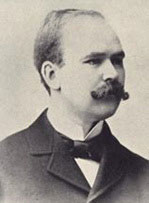
Fred was born on 1 January 1872 in Champion, Pennsylvania, USA. He was the second son of Frank Woolworth's Uncle Elijah and Aunt Mary Woolworth. As Frank's empire started to grow he would visit his Uncle from time to time. The five-and-ten pioneer noted in his diary that by age eight Cousin Fred already wanted to be a shopkeeper. Fred later started work at A.A. Bushnell's in Watertown in 1886, before signing up as a trainee of Charles Sumner Woolworth in Scranton eighteen months later.
Fred went on to work for three different Woolworth companies, starting his career at C. S. Woolworth, moving to F. W. Woolworth & Co. in the USA and finally setting up the first overseas venture, taking the role of founding MD of the F. W. Woolworth & Co. Ltd. Threepenny and Sixpenny Stores. He was treated as the son that Frank never had, quite unlike his brother Herbert G. Woolworth who was ostracized and left to fail after using his training with the five-and-ten to set up in competition.
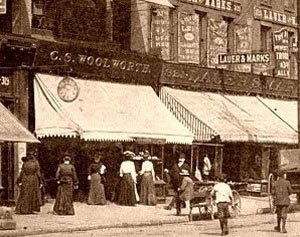
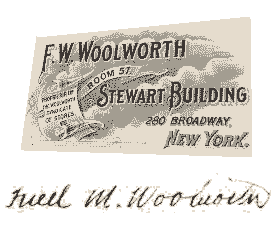
At 16 Fred started in Scranton working for his Uncle, Charles Sumner Woolworth.
'Sum' patiently taught him about managing people, buying products, controlling expense and serving customers.
After earning his spurs in-store and demonstrating strong commercial acumen, he was headhunted by Frank Woolworth for a new role assisting his Office Manager in the Buying Office in New York. His new boss, Alvin Ivie, had worked with the Woolworths in Moores at Watertown. The two men held the fort twice a year when Frank Woolworth headed to Europe for new products. Ivie took Fred under his wing and helped him to hone his product selection and negotiation skills. To complete his training, Fred also learnt about book-keeping and accountancy from another of Frank's protégés, Hubert Parson. He hankered after a store of his own.
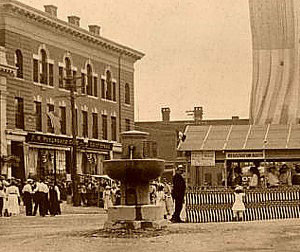
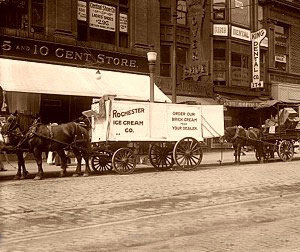
In 1901 he took the helm at Lewiston, Maine,
In 1906 he took on the flagship in 6th Avenue, NY, incorporating the 5 &10¢'s Central Warehouse and a bird's eye view of its huge range.
The Woolworth brothers systematically groomed their cousin for a leadership role. By 1909, thirty-seven year old Fred had managed a small store and one of the largest in the Syndicate. He had also learnt about Buying, Accounting and the Supply Chain and had an encylopaedic knowledge of the merchandise and suppliers. Perhaps the whole UK venture was engineered to find a role for cousin Fred. Certainly when Frank called for volunteers, Fred was the first to step forward. Within weeks he and his wife had packed up their American home and they were ready to to set sail for England. On the docks they met up with Uncle Frank and Auntie Jennie, Fred's Superintendent Byron Miller and fellow-manager Samuel Balfour. They set sail on Decoration Day, 5 May 1909.
 Arriving in the UK, Fred and Frank set out on search for locations. They were joined by scouts from the USA. He had to learn quickly as Frank believed that the British Company would need to reach critical mass as soon as possible to make the Threepenny and Sixpenny Stores work.
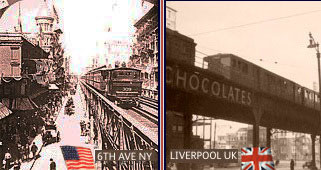
One of the things that struck Fred was the similarity between Liverpool and New York (left). Both were large, populous and expanding rapidly. Both had invested in new public transport including tramcars or trolleys and elaborate overhead mass transit railways.
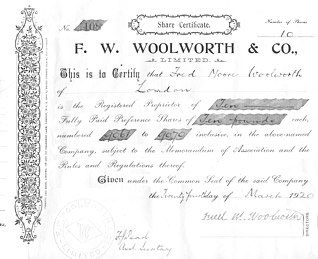 Fred's other task was to create the Company structure, finding Solicitors and setting up regular meeting and control structures. His original Minute Books, Share Certificate Books and Great Seal still survive.
Within a few weeks Frank Woolworth became restless. He returned to New York in July. Over the next three months he relied on letters and telegrams from Fred fto track progress.
It is a testament to the founders that, despite the challenges faced in Britain, they launched cheaply. Frank set up a £100,000 reserve fund, but the the initial openings, including shopfittings and stock, were all funded his £50,000 investment.
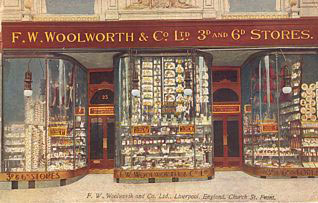
Fred Woolworth cut the ribbon to open the first British store in Church Street, Liverpool on Friday 5 November 1909. He entertained an invited audience to tea and cakes in the sumptuous refreshment room on the second floor. Visitors were not allowed to buy anything. A preview day was a longstanding tradition from the USA. Journalists and local dignitaries were invited to take a look ahead of the public. The following day the store attracted a huge crowd and recorded bumper sales. Fred was proud to report the success to his Uncle, who had been pacing in his New York office, anxious for news.
A particular triumph was persuading Owen Owen, a local businessman and the proprietor of a successful chain of department stores of the same name to sublet one of his buildings in London Road, Liverpool to the Threepenny and Sixpenny Stores. The endorsement proved helpful in securing other offers of property. The entrepreneur declared himself surprised that the bazaar business could look so good, and offered a 21 year full repairing lease at a fixed rental. Woolworth's remained a tenant for more than sixty years.
By Christmas the Woolworth scouts had secured properties in a line across Northern England. By the following summer the chain would stretch from Liverpool to Preston and on to Manchester, Leeds, Hull and Middlesborough. Meanwhile Frank booked a passage from New York to Liverpool to celebrate the success of the first store. The trip also allowed him to accompany Fred on a search for properties in London and South East England.
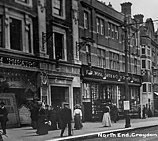
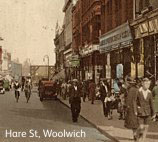 They chose to open the first London store in the fashionable Brixton district, about three miles to the South West of the city centre. This was followed by Woolwich to the East (right), Harlesden to the North and Croydon to the South. The original Croydon building went on to serve the company for 97 years. Fred Woolworth reviewed and agreed each lease, bearing witness that landlords liked a "real live Yankee".
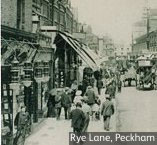
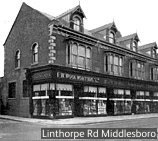
The next stores in London Road, Liverpool and Fishergate, Preston proved to be instant hits. A new Director, John Snow, laid on spectacular entertainment for the big day, while also adding new ranges. Fred insisted on checking every item to enforce his 'Buy England' policy. He instructed the Buyers to seek 'carriage forward' terms from suppliers, meaning that they picked up the tab for the supply chain with the cost.
After five years at the helm, Fred Woolworth's results were stellar:
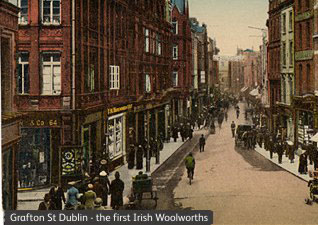
- 44 stores opened, spanning England, Wales, Scotland and Ireland
- every branch was profitable
- over 90% of the products were British-made
- all but two stores were British managed, with just two Americans in-store
- the postbag was inundated with nominations for new stores
- the dividend had exceeded 20% every year
- all leases and fixtures had been funded from growth
- rivals the 6½D Bazaar had folded and closed
- M&S Penny Bazaars still preferred market stalls
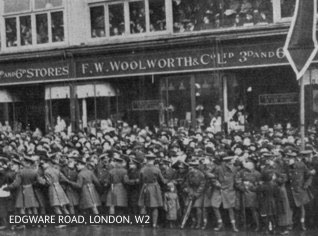 The Great War proved a stern test. A wave of patriotism swept the nation, prompting many male staff to sign up for military service. U-boats threatened the chain's supply routes from Europe and outwards to the USA. The parent company offered to send reinforcements. but Fred declined at once:
"Send soldiers if you wish to end the war by Christmas STOP. No Managers needed as stores fully covered STOP".
Fred was proud of his formula. Women could step up to cover for Managers who were away. He planned to accelerate openings to exploit a drop in property prices as war raged on.
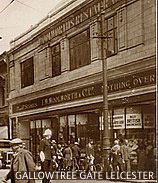
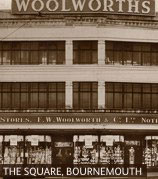
It is hard to imagine now that life continued largely as normal throughout the War. It was fought on foreign fields by brave, patriotic volunteers. Everyone else tried to keep things normal at home. There was no rationing, no curfew and even no black out in the first years of the war.
Fred Woolworth's "Buy England" policy was perfectly timed. Stores had just enough high margin local goods to keep the counters full, avoiding freight costs from North America.
The openings programme kept profits growing even without the benefit of some of Frank Woolworth's best lines from the USA.
On 31 July 1921 the hundredth British Woolworth store opened in Westgate, Mansfield, Nottinghamshire. Expansion had continued at pace throughout the Great War. Under Fred Woolworth's leadership each opening had been carefully planned in advance, with only one in three of the schemes proposed by the Property Department finding favour from the Board. The MD led from the front and rigourously examined each set of costs and sales projections, sending many schemes back for re-work. Thanks to his meticulous attention to detail every store in the chain was profitable and the contribution per store far exceeded the equivalents in the USA. The MD approached meetings with his Buyers and Superintendents with the same zeal, keeping the executives on their toes and not allowing any deviation from his strict standards. The firm direction helped to establish a clear brand identity and to set the chain on the road to even greater success.
 Fred's energetic style started to impact his health. He gave each store the same level of attention when ithe chain was 100 strong as in earlier times, opening each one personally and taking time to meet the customers and staff.
Most employees considered him a friend, with all seeing him as a larger than life character. There was admiration from the USA too, with a widespread view that it wasn't just his surname but sheer hard work that had made him reach. After all he had volunteered and could have lost everything.
In Summer 1922 Fred Woolworth returned home to visit his elderly mother, who was in poor health. He suffered a stroke while in the USA, which doctors believed was the result of years of overwork. He insisted on hurrying back to Britain to the helm of his beloved company. His illness was kept a secret from everyone except his Board colleagues, who granted him a leave of absence from their Meetings during the Autumn and Winter while he recouperated in his London home. In early January he returned to work and was well enough the chair the Board's post-Christmas meeting. Days later he suffered a second stroke and died on 27 January 1923.
Everybody was shocked at the loss of such a vibrant man at the young age of 51. The stores closed on hearing the news and again for the funeral as a wave of grief swept the company. Many Managers and their staff sent condolences to Mrs Woolworth and Fred's son, Norman Bailey Woolworth. The Company President, Hubert Parson, travelled to London for the funeral of his friend and one-time trainee. He also tabled a moton of condolence which was read at a full shareholder's meeting attended by the whole British Board. The resoluton survives. It was hand typed and signed in ink. It reads:
MINUTES OF A SHAREHOLDERS MEETING OF F. W. WOOLWORTH & CO. LTD.
HELD AT VICTORY HOUSE, KINGSWAY, LONDON, W.C.2.
ON MONDAY, MARCH 26TH 1923 @ 10.30 A.M.
PRESENT: W.L. Stephenson, C.H. Hubbard, C.W. Gasque, J.B. Snow,
R.H. Parker, N.B. Woolworth, H.T. Parson
RESOLUTION OF SYMPATHY IN RE THE LATE FRED MOORE WOOLWORTH. On motion made by H.T. PARSON and seconded by C.H. HUBBARD, the following Resolution was adopted by a rising vote:
RESOLVED that the Shareholders of this Company wish to record their deep sympathy and regret at the loss of their Managing Director, Mr. Fred Moore Woolworth, who departed this life January 27th, 1923.
He was one of the pioneers who started this business and had been active in its management and organisation since its incorporation and start in business in 1909. The growth of the business and its increase year by year was due primarily to his able management and direction, and the Shareholders as a body wish to record in this Resolution a unanimous approval of his Directorship and acknowledge that many of the principles which he established in the business will carry it on to further success.
These Resolutions are ordered spread in full on the Minutes, and it is directed that a properly engrossed copy, signed by the Managing Director and sealed by the Company, be presented to the family as a token of appreciation for his life-work.
CONFIRMED:-
W.L. Stephenson, CHAIRMAN
Shortcuts to related content in the Woolworths Museum
1900s Gallery
US Expansion:
US Biographies:
UK Biographies:
UK beginnings:
Financing and setting up the Company
Join us on opening day in Liverpool
Museum Navigation