Welcome to the Original Virtual Museum - celebrating Woolworths' century at the heart of British High Street Shopping
 -  -  -  -  -
please click a menu button
please click a menu button Original Virtual Museum Home Page please click a menu button The Woolworth value store concept is born in the USA please click a menu button Laying the foundations as the first British Woolworth store opens in Liverpool in November 1909 please click a menu button Woolworths rapidly open forty-four stores in Britain and Ireland before facing a World War please click a menu button Bigger, brighter and bolder Woolworth stores in the Roaring Twenties please click a menu button Woolworths go to amazing lengths to keep all prices under sixpence in the Thirties please click a menu button Bravery and defiance during World War II in Woolworths' finest hour. We pay tribute to the sacrifices made and look behind the scenes please click a menu button Redefining the Woolworth brand for modern times in the 1950s, as prices go up and stores get bigger and bigger please click a menu button Superstores in and out of town, a new own brand and the opening of overseas Commonwealth stores during the 1960s please click a menu button Woolworth struggles to keep up during the rapid inflation and change of the 1970s please click a menu button Woolworth stores in more recent times, covering the period 1980-2008 please click a menu button
please click a menu button please click a menu button please click a menu button please click a menu button please click a menu button please click a menu button please click a menu button please click a menu button please click a menu button please click a menu button please click a menu button
Background to the Original Virtual Museum and copyright information about the contents Origins of the firm's legendary pic'n'mix and a century of chocolate, candy and confectionery in the High Street A century of music and entertainment in the High Street from sheet music and gramophone records to CDs and blu-ray discs A century of toys, games and fun in the High Street stores of F. W. Woolworth A century of fashion in the High Street, from paper patterns and sixpenny knickers to an extensive range of award-winning Ladybird clothing A century of cards, pens, pads and books from the shelves of F. W. Woolworth stores Pots and pans, paint and brushes, bulbs and compost and even toiletries - all in High Street Woolworth stores for much of the twentieth century Woolworths pioneered Christmas decorations in the 19th century and supplied presents for our parents, grandparents and great grandparents from their High Street stores Working conditions and pay rates at Woolworths over a hundred years and some of the people behind the brand-name Our cinema, quiz and picture gallery features Visit the new look 21st century Woolworths on line, on the site operated by Shop Direct Group
please click a menu button please click a menu button please click a menu button please click a menu button please click a menu button please click a menu button please click a menu button please click a menu button please click a menu button please click a menu button please click a menu button
 

In praise of the Property Department
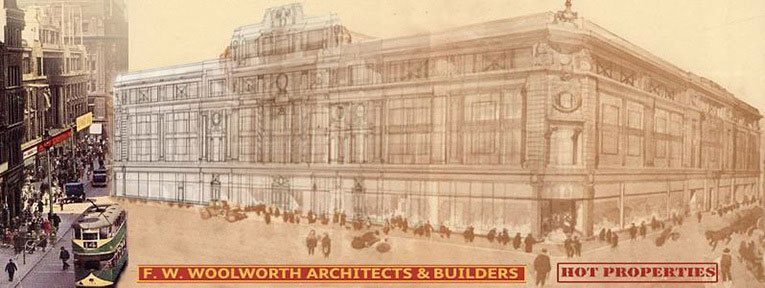
 
Dubbed Liverpool's Cathedral of Commercial, the Woolworth Building dominated Liverpool's Church Street when it was completed in 1923. It took the place of the City's Pro-Cathedral. Today the building has been converted to form the Liverpool One Shopping Centre
 
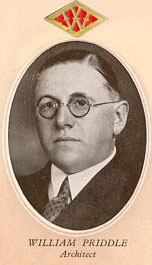
William Priddle, the F. W. Woolworth & Co. Ltd. architect behind virtually all of the pre-war store design, and mastermind behind the Liverpool "Cathedral"

In 1923 the Woolworth Board set a new challenge. It fell to their Property Department and Construction Team bring the plan to life. They had to juggle three priorities:

  • expanding faster, trebling the rate of openings
  • relocating and extending the existing stores
  • building an asset base of freehold property, constructing 'made-to-measure' stores

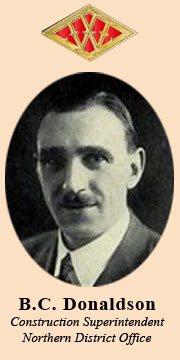
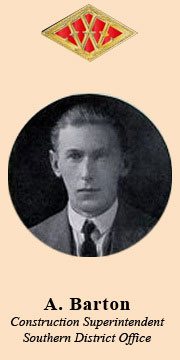
The work was led by the Company Architect, William Priddle. He was supported by two regional Heads of Construction, B. C. Donaldson in the North and A.Barton in the South. All three men excelled.

Priddle came up with a simple, repeatable design for a standard store, and individual drawings and architect's plans for special locations like Liverpool Church Street (illustrated above). The Construction team was expected to get basic stores open in under seven weeks and to develop major sites like Liverpool in under six months.
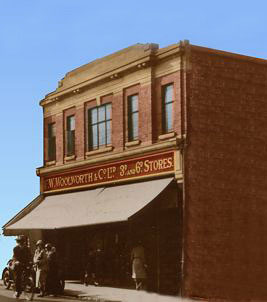

William Priddle designed a Woolworth-standard store in the early 1920s (right). It had a distinctive stone-effect parapet at roof-level and around the fascia above the windows and doors. It also had symmetrical windows at first-floor level, could be built from red, orange or yellow bricks and had a red name sign with gold lettering.

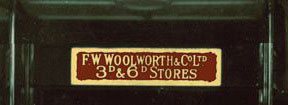
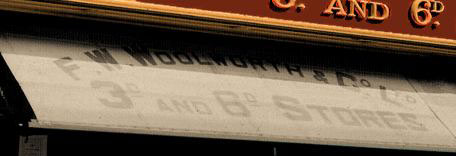
Every store was fitted with sunblinds (normally lettered "Nothing over 6D"), and brass-on-cast-iron F. W. Woolworth & Co. Ltd. signs at the base of each window. The transom above the doors (with gold letterings sandblasted onto red glass in a mahogany surround) also read F. W. Woolworth & Co. Ltd. 3D and 6D Stores, while the windows and doors had a mahogany finish.

Thanks to the skilled materials acquisition and bulk buying of Louis Denempont (who also chose many of the locations), the Construction Team could build a store from scratch in seven weeks. The total cost was under £4,000, including the mahogany counters and tills and the fitting of the ancillary accommodation.
"The standard model Woolworths" - featured in High Streets up and down the land since the 1920s, and designed by the Company's in-house architect, William Priddle
 
Sunblinds were more or less permanently down in the summer months during the 1920s, emblazoned with the F. W. Woolworth 3D and 6D Stores name and, in some case, the chain's "Nothing over 6D" slogan

The transom sign above the doors of a 1920s British Woolworths

< Sun blind            ˆTransom sign above the door

 
Construction Superintendent B.C. Donaldson, who worked for Woolworths for more than forty years, not only building many of the chain's stores, but later extending and refurbishing them and even restoring them after the blitz. His motto was "We can build one overnight!"
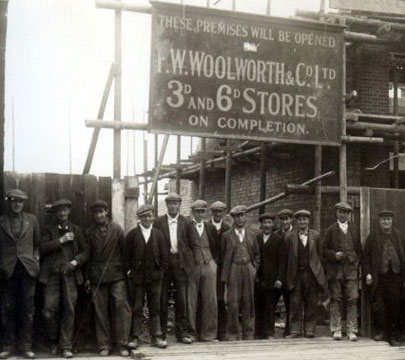
The Woolworths construction workers pose for the camera on the site of  a new standard-model store in the 1930s
A Barton, who was construction supervisor for Southern Britain in the 1920s

The steps involved in opening a store were:

  • choosing a potential town, often based on suggestions from the public or an invitation from the local authority
  • identifying a site, preferably building land or delapidated premises ready for demolition
  • developing a store design, either adapting the standard template to the shape and size of the plot, or sometimes custom-drawn
  • considering possible tenants and rents for any surplus space that would be created or purchased as part of the deal
  • costing up the proposal, negotiating the price of any freehold or rent, and estimating the costs to clear the site, build and fit out the premises; in some cases different "schemes" offered a choice of size and investment level for the Board to consider
  • estimating the sales and profit potential and indicating the approximate lead time between sign off of the proposal and opening
  • presenting to the District Manager and Louis Denempont ahead of review with the Board or later the Investment Committee
  • commencing the building work within 48 hours of the freehold or lease becoming available

A Woolworth craftsman was appointed Site Manager and would oversee every detail of the work. He would control the bricklaying, plumbing, wiring and shopfitting. The construction teams were legendary in the industry. Each group was self-contained and had a full spectrum of highly skilled people. Workers received bonuses if they completed a store on or ahead of time. To receive the maximum payment they had to work in all weathers, at lightening speed. Arc lights were used to allow work to continue late into the night. The Site Manager had the option to top-up his team with local builders if he felt this was necessary.

It is a tribute to the pride that Priddle, Donaldson, Barton and their teams put into their work that the great majority of the stores they built are still standing. Although many are now occupied by new tenants, the distinctive look has survived.
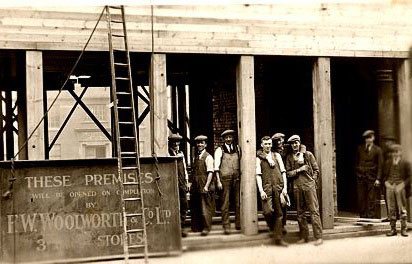
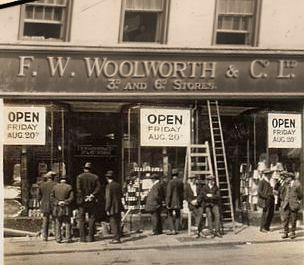
 

The Woolworths construction team takes a break. Less than a fortnight later the new store at New Malden, Surrey was open for business.
The Construction Team look-on as the District Manager admires his new F. W. Woolworth shop, due to open the next day
 
You will find more about the opening of the flagship store in Church Street Liverpool (the finished results of the plans at the top of this page) in the next exhibit in the 1920s Gallery here in the Original Virtual Museum.
 

If you have enjoyed our Virtual Museum website, why not check out our complete history of Woolworths in a 194 page, richly illustrated paperback book?  A Sixpenny Romance is just £10.99, with free delivery in our on-line shop.
The special DVD, the Wonder of Advertising, is now available in our on-line shop for £7.50 with free delivery. A fully illustrated 194 page history of Woolworths, or a selection of professionally authored DVDs in our on-line shop