Welcome to the Original Virtual Museum - celebrating Woolworths' century at the heart of British High Street Shopping
 -  -  -  -  -
please click a menu button
please click a menu button Original Virtual Museum Home Page please click a menu button The Woolworth value store concept is born in the USA please click a menu button Laying the foundations as the first British Woolworth store opens in Liverpool in November 1909 please click a menu button Woolworths rapidly open forty-four stores in Britain and Ireland before facing a World War please click a menu button Bigger, brighter and bolder Woolworth stores in the Roaring Twenties please click a menu button Woolworths go to amazing lengths to keep all prices under sixpence in the Thirties please click a menu button Bravery and defiance during World War II in Woolworths' finest hour. We pay tribute to the sacrifices made and look behind the scenes please click a menu button Redefining the Woolworth brand for modern times in the 1950s, as prices go up and stores get bigger and bigger please click a menu button Superstores in and out of town, a new own brand and the opening of overseas Commonwealth stores during the 1960s please click a menu button Woolworth struggles to keep up during the rapid inflation and change of the 1970s please click a menu button Woolworth stores in more recent times, covering the period 1980-2008 please click a menu button
please click a menu button please click a menu button please click a menu button please click a menu button please click a menu button please click a menu button please click a menu button please click a menu button please click a menu button please click a menu button please click a menu button
Background to the Original Virtual Museum and copyright information about the contents Origins of the firm's legendary pic'n'mix and a century of chocolate, candy and confectionery in the High Street A century of music and entertainment in the High Street from sheet music and gramophone records to CDs and blu-ray discs A century of toys, games and fun in the High Street stores of F. W. Woolworth A century of fashion in the High Street, from paper patterns and sixpenny knickers to an extensive range of award-winning Ladybird clothing A century of cards, pens, pads and books from the shelves of F. W. Woolworth stores Pots and pans, paint and brushes, bulbs and compost and even toiletries - all in High Street Woolworth stores for much of the twentieth century Woolworths pioneered Christmas decorations in the 19th century and supplied presents for our parents, grandparents and great grandparents from their High Street stores Working conditions and pay rates at Woolworths over a hundred years and some of the people behind the brand-name Our cinema, quiz and picture gallery features Visit the new look 21st century Woolworths on line, on the site operated by Shop Direct Group
please click a menu button please click a menu button please click a menu button please click a menu button please click a menu button please click a menu button please click a menu button please click a menu button please click a menu button please click a menu button please click a menu button
 

Buying Ingenuity in the 1930s

Bakelite is Beautiful - Woolworths were one of the first British companies to stock bakelite - the first plastic which allowed new products to be brought to market for sixpence or less in modern shapes and bright colours
 
During the Thirties Woolworth's Buyers excelled. They sought new lines and developed an exceptional track record of identifying winners, backed by the courage to place big initial orders. They were also imaginative in designing displays that made even the most mundane item look interesting and exciting. The firm's paper-based 'merchandising system' allowed them to track the sales of "try out" items in selected stores, long before the days of barcodes and EPOS scanning technology. Fast sellers were quickly extended across the chain.
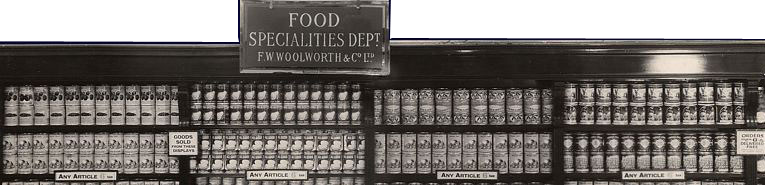
 

Tinned fruit was a new range for the 1930s, developed by Woolworths Buyer Bill Lacey


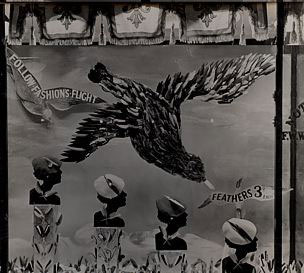
Follow fashio's flight - an unusual window display at the F. W. Woolworth store in Balham, South West London before World War II


Building on the success of the range of their kitchen shop, the firm added everything customers needed for a picnic. Tinned fruit and canned cream became best sellers. Gas fittings were replaced by a new electrical department, which gave away leaflets to explain the new 'clean fuel' to shoppers. The toiletries offer was expanded with a selection of cosmetics in small sizes. These were a hit with budget-conscious girls.

Some successes were a surprise, even to the Buyers. They joked that individual feathers 'flew out'. These were sold for threepence each as accessories for hats and gowns. They helped the Balham, South London branch to win the regional window-dressing contest of the popular Daily Express  newspaper. The dresser had painstakingly recreated a bird out of the feathers and had captioned the window 'Follow fashion's flight'.
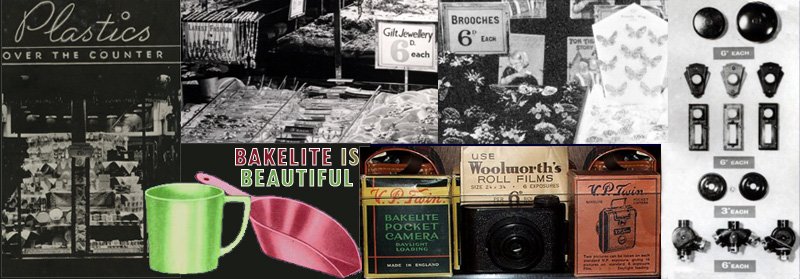
 

Bakelite was a revolutionary new material in the 1930s. Woolworth was the first British company to recognise its potential, spawning many ranges across the stores


Woolworth was the first firm to spot the potential of a new wonder material in the Thirties that spawned a highly diverse selection of items. Bakelite was an early form of plastic. It could be moulded into any shape when molten and dried to a durable, rock hard finish. Initially the firm ordered a selection of cups and beakers, going on to stock a wide range of electrical plugs, sockets and switches, mainly a dark plain brown colour. But over time suppliers came forward with much more imaginative uses for the new material.

Switches and sockets were offered in brighter colours, including a mother of pearl cream and a duck egg blue with a white fleck. A supplier called Otto Rand secured a large order for 'Galbontz' jewellery. He made Bakelite into brightly coloured butterfly brooches as well as ear-rings and pendants. They were cheap to make, looked smart and, despite the sixpenny price ticket, offered a good margin.

The signature Bakelite item was the 'VP Twin' camera. This was developed by the Eliot Manufacturing Company, and was initially offered for sixpence (2½p at the time, the equivalent of £2.11 today). Apart from a glass lens and a metal button, it was entirely made from Bakelite. It could take six pictures on a standard film. The rolls were offered for threepence, or for sixpence inclusive of developing and printing. The camera proved to be the best-seller of 1936. As raw material prices rose between 1937 and 1939, the camera was offered in kit form, comprising two and later three sixpenny pieces.
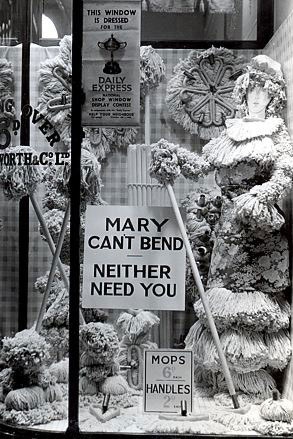
 

A mundane product gets an innovative window display - mops and handles in the window of Woolworths in Balham before World War II

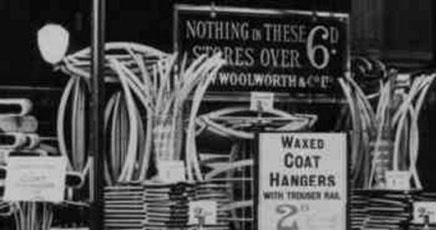
Many of the new items were much less glamorous. Good presentation drew attention to the chain's low prices and boosted sales of everyday items like buckets, bowls and coathangers. It seemed that even the dullest line could be transformed into an art-form. Window displays like the ones illustrated could drive a ten- or twenty-fold increase in demand.
 

Making the product the star.  Everyday items were used to create spectacular window displays like this show of hangers in the Church Street, Liverpool Woolworths in 1930.

Above: Hangers window display at Church Street Liverpool in around 1930

 
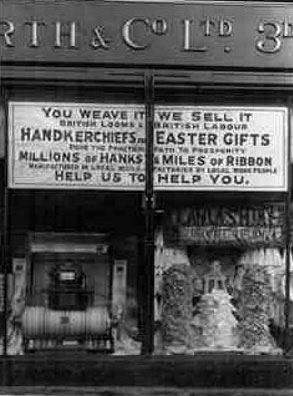
Promoting local goods in the local Woolies - a very successful marketing campaign of the 1930s.  This Lancashire cotton window was built by colleagues at the Bolton store (No. 16) in the 1930s.

While most window displays were based on instructions from the District Office, Store Managers were given latitude to set up occasional features of their own. The Buyers actively encouraged them to make contact with local factories that supplied the company. This led to a number of mutually-beneficial initiatives in which the manufacturers lent out equipment or raw materials to complement their products in spectacular window displays. These were often pitched to coincide local carnivals and wakes week holidays.

A particular favourite, which regularly made the rounds across North West England, was first inspired by staff outings from the Rochdale, Bolton and Preston stores to a local mill. The supplier loaned bales of raw cotton and a large loom to promote their handkerchieves and undergarments. A large sign proclaimed "You weave it, we sell it ... help us to help you".

As well as boosting sales, the promotion earnt a lot of goodwill in the community.
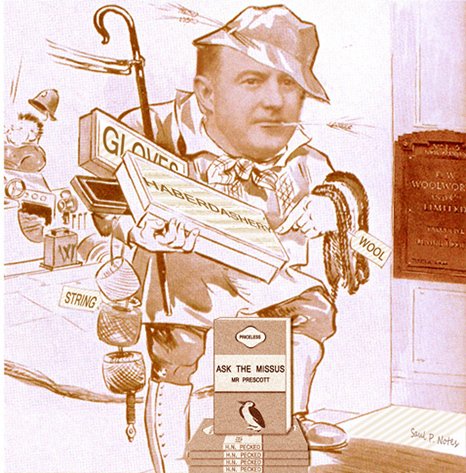
 

Penguin Books made their first major sale to Woolworths' buyer E. Clifford Prescott in 1935, but only thanks to the timely intervention of his wife!

One very popular range in the late 1930s nearly got away. A young man called Allan Lane waited patiently in the reception area at the Mayfair headquarters in New Bond Street House, for a short meeting with the Fancy Goods Buyer, E. Clifford Prescott.

Lane had developed the idea of a 'paperback' book for sixpence. He hoped to persuade the Woolworth man to order his 'Penguins', which included lots of popular titles. Initially it seemed his pitch was falling on deaf ears, as the Buyer seemed distracted and kept looking at his watch.

Then the tide turned. Prescott's wife poked her head around the door to remind him that she was waiting to be taken for lunch. He hastily explained that she was on a rare shopping excursion into town. Before he could shepherd her out, she spotted an Agatha Christie Poirot story among the samples. She mused that if Woolworth's offered soft cover books like that for sixpence she would surely buy regularly.

A few minutes later Lane left smiling, clutching a substantial Woolworth order, which he later admitted was life-changing. Penguin Books became one of the top-sellers for the next five years. Stationery gallery.


Quick Links to other exhibits in the Original Virtual Museum

1930s openings   Stock Market Flotation   Buying ingenuity

Working in a 30s store   Woolies' first character items   Keeping prices under sixpence

Eclipse & Crown records    Woolworths' first Ladybird items    Royalty and Empire

"New Bond" staff magazine   First catalogues    Restaurant & Tea Bar   Rumblings of War

Museum Home Page   1920s Gallery   1940s Gallery


If you have enjoyed our Virtual Museum website, why not check out our complete history of Woolworths in a 194 page, richly illustrated paperback book?  A Sixpenny Romance is just £10.99, with free delivery in our on-line shop.
The special DVD, the Wonder of Advertising, is now available in our on-line shop for £7.50 with free delivery. A fully illustrated 194 page history of Woolworths, or a selection of professionally authored DVDs in our on-line shop