The Woolworths Museum
John Ben Snow
(1883 - 1973)
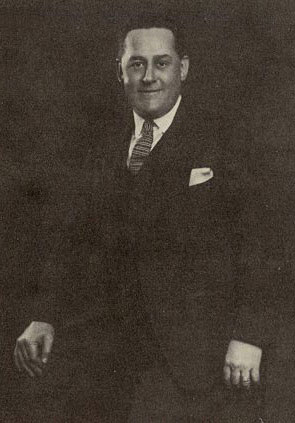
John Ben SNOW was born in Pulaski, New York on June 16th, 1883. A College graduate, he met Fred Moore Woolworth in 1906. Fred suggested a career with the Company but counselled John not to mention his qualifications as cousin Frank respected only hard-work and commitment. John took heed of the advice and offered to work without pay while he learned the ropes. He signed up as Fred's trainee at the flagship store in Sixth Avenue New York (which at the time paid a rental of $20,000 a year!). Within twelve months Snow was rewarded with a store of his own at Port Jervis, in New York State.
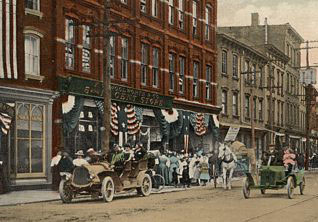 He decorated his store with flags and majored on high margin novelties. Frank Woolworth liked his style!
Snow took on the large store at 47th & 8th in Manhattan. He was paid $10 a week plus 25% of profits.
The Manhattan store was a real feather in John's cap - but more was to come. While he wasn't much of a salesman, he quickly built a reputation as a great Buyer. He topped up the novelties from the Buying Office with local purchases, and drove big sales as a result. Before long word reached Frank Woolworth at his headquarters in the Stewart Building in New York City. He instructed that Snow's best items should be offered nationally.
When Frank Woolworth was looking for volunteers for the British expedition, Snow was one of the people he approached. Unfortunately he had just lost his father and was making arrangements. He could not accept. A few days after the Liverpool store opened. Woolworth asked again. He promised an executive role and a major earnings opportunity.
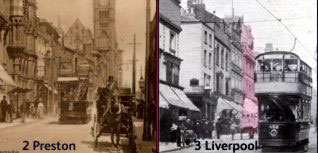
 Snow headed for Britain. On his arrival he took responsibility for the Northern District, with a focus on sales promotion, display and new stores. His first branches were London Road, Liverpool and Fishergate, Preston, which opened in February 1910.
The pre-opening bizazz included fireworks, a full orchestra and lots of theatre. In Britain this was unheard of and attracted huge crowds. Shoppers at London Road got so excited that they burst into the store, knocking counters and sales ladies flying. The police had to restore order. Everyone was delighted that the London Times carried the story. Learning from the experience, he invited the Lancashire Constabulary to take tea upstairs in the Preston store on opening day.
 Snow was elected a Director in 1910, replacing Samuel Balfour, who returned to the USA. Records show that John chaired the stockholders meeting in 1912 and secured investor support to double the number of shares in issue. This reflected the success of the expansion programme, which had gone better than planned.
From 1910 until 1913 Snow worked closely with the only English Director, William Stephenson. The two became friends as they applied proven techniques from the USA to choose locations across the North. By September 1913 Woolworth had 28 stores.
In Autumn 1913 Snow was offered the prestigious role of Buying Director in London. Initially he bought China, Glassware, Celluloid Toys and Novelties. Some items were chosen at the firm's rented offices in Oxford Street, others on factory visits and at trade shows. His first major challenge came in 1914, when he had to find new indigenous sources for items previously sourced on the Continent. The trade route had ceased up within days of the outbreak of World War I. Snow was able to cover the shortfall so that most customers did not notice. Growth actually accelerated during the conflict as the formula took hold.
As Frank Woolworth had predicted he was well on the way to becoming a man of means, thanks to dividends on his Preference Shares. He took a smart apartment in Clarendon Court, Maida Vale, which became his London base.
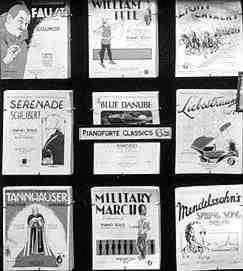
In 1915, war notwithstanding, British profits topped £4m. Snow had contributed handsomely, thanks to the spectacular success of his 'sixpenny pops', which were popular songsheets which he had purchased as an exclusive, royalty-paid from a leading London publisher. Store shoppers could choose between a four-sides of words and music for a single, current hit song, or a booklet containg twenty popular classics condensed into a softcover stapled booklet. Annual sales topped a million units.
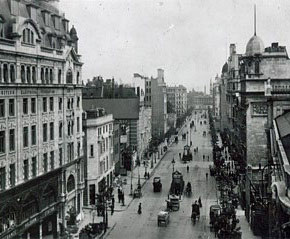 As profits rose, the Board sought new premises for their HQ, securing the upper floors of the newly-built Victory House in Kingsway, WC2, just a stone's throw from W.H. Smith's Offices.
In just six years Woolworth's had gone from debating whether they could pay rent on the first store a month in arrears rather than in cash every week, to signing a tenancy with agents for H.M. King George V's Crown Estate. It is said that Queen Mary of Teck had been an early admirer of the new store at Brixton, and had vouched for the company to her husband!
Snow's oak-panelled office became a hub of activity as would-be suppliers queued in search of a Woolworth order. The buyer gained a reputation for integrity, treating visitors with charm and respect, while driving a hard bargain.
Store openings continued at pace after the Armistice. The firm appeared well placed for a period of prosperity in the Roaring Twenties. In 1923 the untimely death of the founding MD Fred Woolworth at just fifty-one years old prompted a major shake-up. William Stephenson took the helm and appointed his friend John Snow to be the Superintendent of Buying. Stephenson was keen to step up the pace of expansion and abandonned some of the caution of his predecessor. The firm started to develop a distinctive personality compared with its American parent. Snow always kept his finger to the pulse and agreed that anglicizing the offer was the right move, despite his natural allegiance to the USA. The 1920s saw an intense programme of supplier and product development.
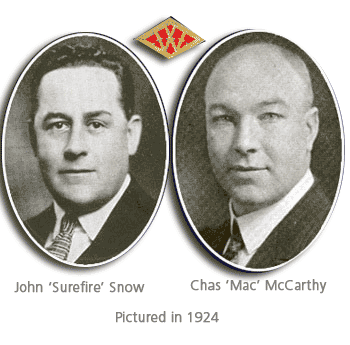
Snow was tasked with developing a ten-strong buying team and showing them the tricks of the trade. As they became established he stepped back, making a point of giving his team members room to manoeuvre. One recruit, Charles McCarthy, who went on to make his name as a highly distinguished buyer of China and Glassware in his own right, described 'JB' as "the most tireless man I ever met". In 1973 he told Snow's nephew and biographer, Vernon F. Snow, that his boss "had possessed boundless energy; he never stopped; he enjoyed a challenge; he thrived on adversity; and he invariably took the bull by the horns".
Snow earned the nickname "Surefire" because he had the Midas touch, consistently spotting winning products that sold quickly.

Snow was a team player. Board Meeting Minutes show he took an active interest in all areas, and contributed ideas to drive profit and make life easier for the staff. He often visited the stores, where he sought out criticism. He used the input to suggest improvements to ways of working to the Board. He earned the nickname 'the best American in the business' by never revealing the source of any criticism, instead concentrating on the savings or sales that could be made.
Members of his Buying Team benefitted from the same support at board-level. When Stephenson sought to cast blame for an issue, he faced the broad shoulders of his Buying Superintendent. Surefire held his hands up and 'took one for the team'. The same Minutes show a self-deprecating, modest man who was quick to give the credit for successes to others.
Like all executives, Snow's package included commission on sales and the right to buy company shares. Continued success brought an annual pay package of £50,000 (the equivalent of £3.5m or $5.6m today). He ploughed much of this into shares, building a portfolio of 50,000 preference shares and 500,000 common stock, which was valued at £12m when he retired.
He enjoyed a rich social life. In addition to his bachelor pad in Maida Vale next to fellow Director Charles Hubbard, he had a passion for horses and bought a stud farm between Hertford and Hoddesdon in Hertfordshire. He engaged a team of professionals to develop a racing stable. He was a keen rider and a celebrated polo player. Highfield Farm became a weekend social centre, where he entertained company executives, American ex-pats and the cream of high society.
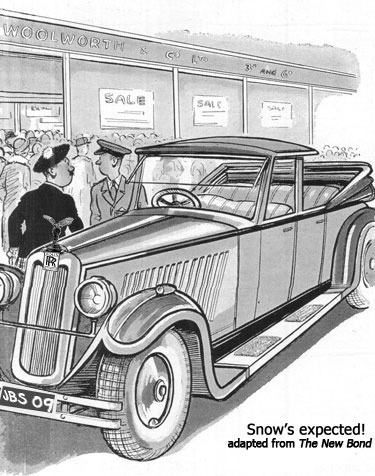
Soon after taking up his appointment in London he treated himself to driving lessons and, after passing his test, a state-of-the-art Rolls-Royce motor car, which became regular feature around the stores and suppliers. His Yankee charm helped him to carry it off without the customary airs and graces.
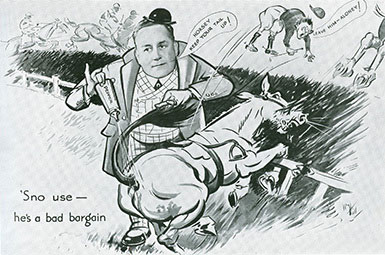
Snow's bachelor status and regular appearances at London clubs and concerts. always with a beautiful woman by his side, contributed to a playboy image in the press. The tabloids speculated that one of his horses would win the 1937 Grand National, describing him as 'one of Britain's most eligible men'.
Stores loved the media comment. It contibuted to a confidence that anyone could make it to the top and become a millionaire if they worked hard. Few colleagues could believe that the unassuming, charming man they had served in-store could be a Director, let alone a millionaire - until they peered out of the staffroom windows to see the Rolls-Royce parked outside.
Behind the scenes he invested wisely and was generous with his friends. He was the silent partner in an American newspaper group that he had co-founded in Port Jervis, New York where he had his first store. Throughout his Woolworth service he kept a back seat, give or take an occasional exchange of letters with his friend Merritt Speidel who managed and expanded the business which he financed from afar. He later became Chairman of the Board of the Newspaper Group after he retired from F.W. Woolworth.
Unlike some of his fellow-directors, who became more British than the English, Snow remained proudly American. Although he only made very occasional trips back to the USA, he considered it home and never made a secret of the fact that one day he would retire from 'working away' and return to the land of his birth. In 1936, at the age of 53, he decided to retire as Superintendent of Buying, to allow more time for his horse-racing and social life. His friend William Stephenson persuaded him to remain a Director of the business that he had served for twenty-six years. He planned to step down in 1940 after thirty years service, but events intervened. He scheduled a short trip to the USA in 1939 to make arrangements for his return the next year. Britain declared war on Nazi Germany during his fortnight at home. Stateside friends persuaded him to resign his role a few weeks early to avoid the risk of another Atlantic crossing. This meant that he left without the chance to say goodbye and without a richly deserved face-to-face 'thank you' for his immense contribution to FWW UK.
Far from slowing down Snow enjoyed an extended third career in the newspaper business after his 'retirement' from F. W. Woolworth. For the next thirty years he corresponded with many former colleagues and friends and followed the British company's progress closely - avidly reading copies of the firm's New Bond House Magazine and its successor the Woolworth News when they arrived in the mail. He set up a charitable trust which continues to fund many educational, church and social projects in New York. He also endowed lots of initiatives in Pulaski, the town of his birth. The 2010 John Ben Snow Foundation Annual Report shows annual donations still exceed $260,000.
John Ben Snow died in his ninetieth year on 21 January 1973. His nephew, Vernon F. Snow, a Professor in the History Department at Syracuse University, wrote a splendid biography to mark his passing, which inspired this article. Originally published by Syracuse University it was republished by North Country Books and remains in print at Amazon.co.uk and other good bookshops. The ISBN is 9780925168160.
We're proud to celebrate the career of one of the great pioneers of F. W. Woolworth in the UK here in the Woolworths Museum.
Shortcuts to related content in the Woolworths Museum
1900s Gallery
US Expansion:
US Biographies:
UK Biographies:
UK beginnings:
Financing and setting up the Company
Join us on opening day in Liverpool
Museum Navigation