The Lighter Side on the Nineties
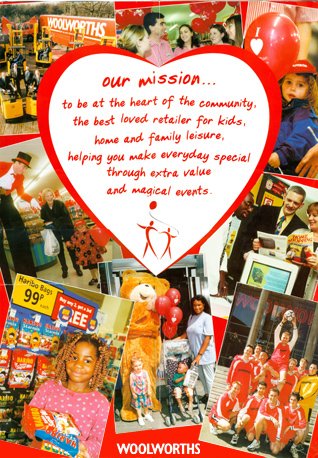
'Our mission ... to be at the heart of the community, the best loved retailer for kids, home and family leisure, helping you make everyday special through extra value and magical events'
In 1998 Kingfisher's rising star executive, Roger Holmes, became MD at Woolworths. He had spent a year preparing for the role, learning from the much-loved veteran, Roger Jones. Holmes aimed to harness the strengths and prepare Woolworths for the Third Millennium. In keeping with the latest management science, he started by summarising of the purpose and goals into an updated 'Mission Statement'.
As well as outlining the key ranges, it also recognised the strong links which the stores had established with local communities, and the unsung good works that staff did in their home towns. Most initiatives revolved around children.
Holmes celebrated the staff's achievement, with a new registered charity called Woolworths Kids First. Within eighteen months it had achieved its initial objective of encouraging them to kick of 2,000 community projects by the millennium. Many more were to follow over the next eight years.
Large stores created 'magical events', wowing shoppers with celebrities, fashion shows and even swap-shop events on Saturdays and in the school holidays. Buyers developed extra value offers. The initiative harnessed the enthusiasm of the staff and strengthened their pride in the brand.
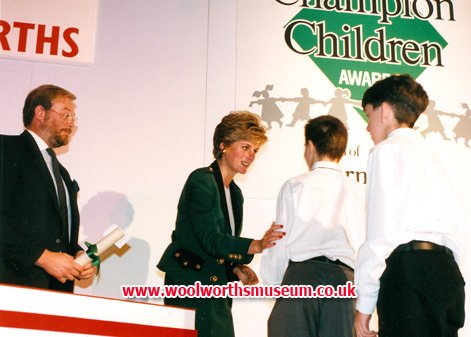
The mission statement capitalised on a series of Kids-related events throughout the 1990s. The Company had sponsored the Barnado's Champion Children Awards, as well as initiatives to support Childline, and Help a Child to See.
The initiatives had already established strong links between many stores and their local communities. Many colleagues gave time rather than money.
The external perspective also helped the Store Managers to develop their leadership skills and proved an effective way of improving teamwork in the stores.
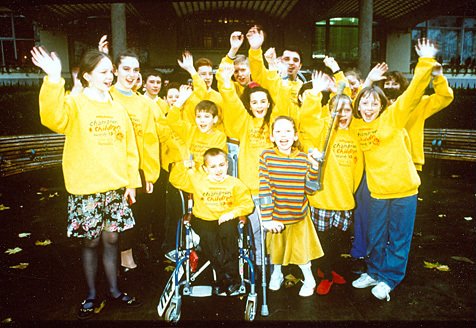
The initiatives also brought another benefit. They opened Managers' eyes to some of the issues facing the disabled. One came up with an initiative that proved that it was possible to make a big difference at negligible cost.
Spotting the difficulty that some people had in navigating the aisles of his store, he suggested that each branch should be sent a plank of wood the width of a double-buggy or a motorised scooter for the disabled. He got fellow Managers to walk their stores with the plank to spot and tackle bottlenecks in-store.
The idea effected more of a change than the subsequent Disability Discrimination Act, because it was simple and practical.
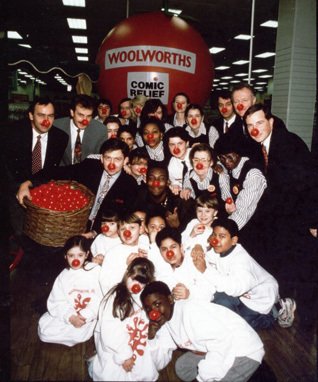
Woolworths supported Comic Relief for much of the 1990s, becoming the main outlet for Red Noses and raising money through the stores. Company Directors entered into the spirit of the event, with no less than five (Chris Ash, Don Sloan, Dan Bernard, Martin Toogood and Jim Glover) volunteering for a photocall with Lenny Henry and Peter Taylor and his staff in the Edgware Road store near the Marylebone headquarters in London.
The firm stepped aside in favour of the supermarkets when Kids First was adopted as the dedicated company charity.
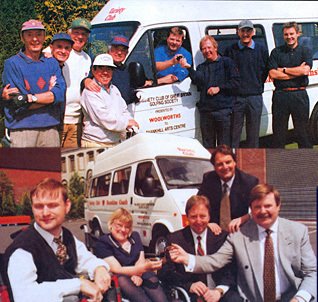
The Variety Club's Sunshine Coaches inspired the chain's golfers. Distribution supremo Jim Spittle led a team of fund raisers. He handed over a minibus to legendary armchair storyteller Ronnie Corbett, himself a great lover of the sport.
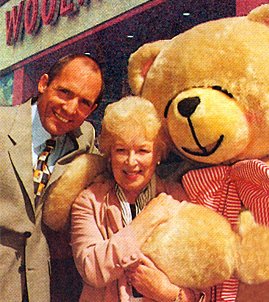
Weeks later he repeated the feat, handing over a second vehicle to Tim Brooke-Taylor for the Shankhill Arts Centre. The chain also gave five pence for every 'Forever Friends' card sold, inviting their popular Edgware Road Store Manager to present the cheque to screen legend June Whitfield along with a seven foot teddy bear (above, right).
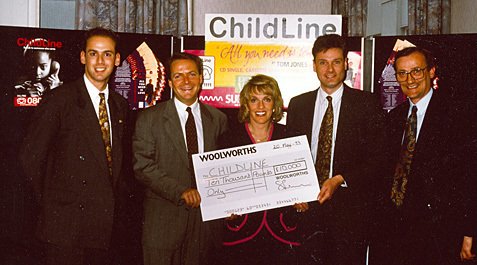
Store staff were so moved by That's Life star Esther Rantzen's campaign to protect children from bullying and abuse at home, that they encouraged Company bosses to donate £10,000 to help get the new service off the ground. HR Manager Ian Woodward handed over the giant cheque, accompanied by members of Andy Baines' Marketing Team.
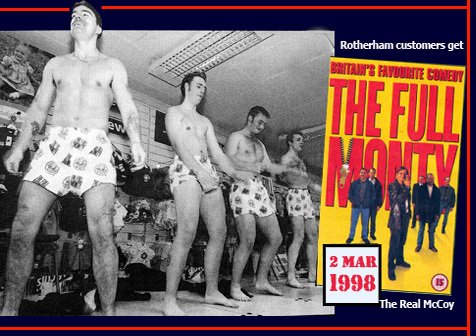
Altogether raunchier was a floor show at the Rotherham store to mark the release on video of the smash-hit film 'The Full Monty'. In keeping with the plot, in which redundant steel workers find an unusual way to make a living after their plant closes, a popular local group of male strippers 'The Real McCoy' were hired to strip to their 'Full Monty' boxer shorts for the benefit of a packed store of shoppers. The event was broadcast on BBC TV's Look North and received extensive national media coverage.
The scantily clad performers went on to carry two sales assistants shoulder-high around the store to rapturous applause from the crowd! Buoyed by the event, the store sold a remarkable £80,000 worth of the £9.99 video over the following week, along with 3,000 copies of a 'perfect partner' film for £2.
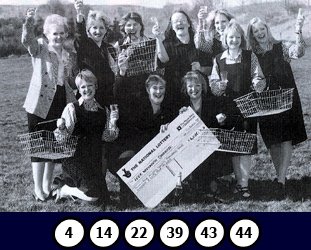
Perhaps the most remarkable story of the 1990s was news in Spring 1998 that a syndicate of fourteen colleagues had won the £4m jackpot in the National Lottery. Each took home a jaw-dropping £287,211.
The red top press dubbed the win 'The Wonga of Woolies' and reported that everyone planned to stay working in the store. The Assistant Manager, John Roberts, explained to the house paper, Woolworths News, 'at the moment everyone's staying at the store... we're that close, everyone gets on so well. It's almost like a family runs the store.'
Sales Assistant Eileen Holland, who had served for 23 years, told The Sun 'Woolworths has become part of my life. We're like one big happy family. Even shoppers are coming up to congratulate us'.
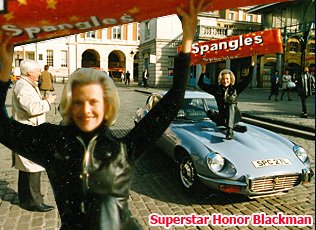 As the largest confectioner in Europe, the stores were often chosen to launch new sweet brands. The Buyer was also able to persuade suppliers to restore several favourites to the shelves. According to press reports it 'forced' Cadbury's to reinstate Bournville Boxed Chocolates, alongside its new Biarritz brand. Terry's agreed to supply Devon Milk in half pound (227g) and pound (454g) boxes. Mars relaunched the sixties favourite, Spangles, at Woolworths with panache. The supplier hired popular Bond-girl and TV star Honor Blackman for a photocall. She posed, Spangles aloft, on the bonnet of an e-type Jaguar in London's Covent Garden.
The long-serving Trading Controller Chris Willis, the man behind the continued success of the sweets offer, also played a part in getting Mars to make Ice Cream, which soon became an international best seller. But even he couldn't rename Snickers as Marathon or M&Ms as Revels and Treats !
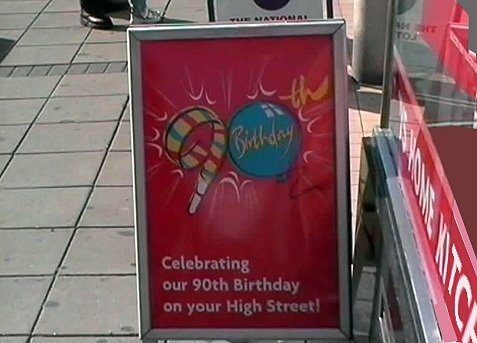
With a new mission, Kids First's 2,000 community projects, and new stores opening again, even in London, the ninetieth birthday deserved to be celebrated as Executives held their heads high.
Woolworths went into the millennium banking annual profits of around £100m. No-one dreamt that almost exactly a decade after the Ninetieth Celebrations they would be attemdomg a wake rather than a centenary in 2009, and a decade after that even the world class website had 'retired'.
Shortcuts to related content
1990s Gallery
Limited Story Stores with more specialist ranges
A Standalone Ladybird store - picture gallery
Spectacular £100m profits in 1997
American Woolworth "retires" after 118 years
Keith The Alien brand advertising character
Site Navigation