William Harvey Moore
(1841-1915)
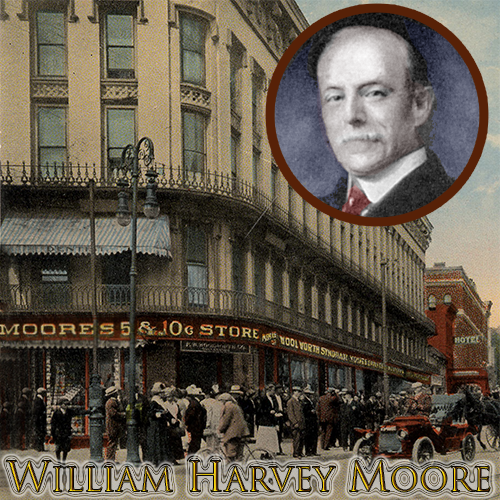
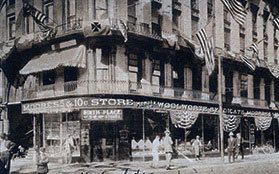
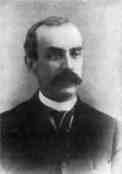
William Moore gave Frank Woolworth his first job at his Augsbury and Moore Dry Goods Store at American Corner in Watertown, New York. Four years later, when Perry Smith had replaced Morgan Augsbury as Moore's partner, the store also took on Charles Sumner Woolworth.
Moore's store went on to become the nexus for the giant Woolworth company, training many early executives and managers, including Fred Kirby, Carson Peck and Alice Coons.
Frank Woolworth recalled his training in an interview with B.C. Forbes in 1917. William Moore had been patient as he fumbled to learn the trade. Frank admitted to Forbes that he had been useless as a clerk. He had asked too many questions and had been so nervous that he had not seen things that were right under his nose. Moore had responded by assigning his charge behind-the-scenes work in merchandising and display. It was under Moore's supervision that he had developed his passion for bold displays in the windows and on the counters in-store. It was also in his time in the Dry Goods Store that he had first come up with his red and gold colour scheme, which became part of the universal five-and-ten identity not just at Woolworth's but also at Kresge, Newberry and Kress.
But Moore was also a tough boss. When Frank demanded a pay rise and threatened to quit, he was shown the door. Woolworth returned with his tail between his legs a little over a year later.
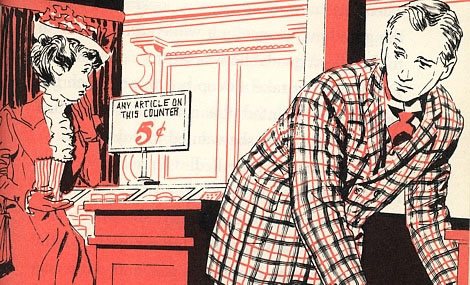 Although Moore was much too modest to say so, it was he who had given the order to set up the fixed price 5¢ table which inspired Frank's first 'Great Five Cent Store'. He also bankrolled it, advancing $300 of stock to help his former clerk to get started.
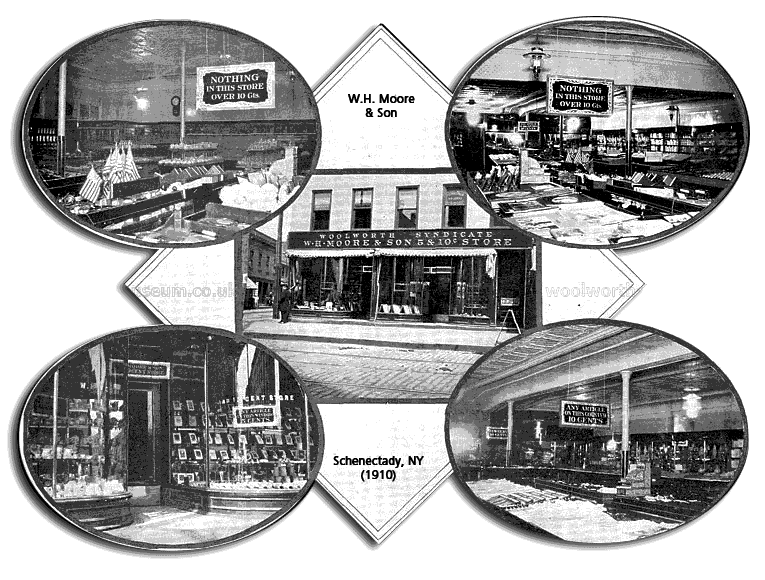
Frank never forgot. When Moore's store hit hard times, he discretely bailed it out. Knowing his boss to be a proud man he never suggested a buyout. Instead he helped his mentor to build his own 5 & 10¢. Later. he made a point of naming W.H. Moore & Sons as a party in the giant merger of 1912, in recognition of Moore's defining role.
 The move brought a windfall to the Moore family. They received almost half a million dollars for their Watertown and Schenectady stores and William's shares in F. W. Woolworth & Co., which he had held since it incorporated in 1905.
71 year old Moore senior was elected an honorary Vice President and Director of the new Corporation. Frank valued his friendship above any other, and was deeply saddened when his mentor died suddenly in 1915 after a trip to the dentist. Frank endured dreadful toothache for the rest of life rather than risk the same fate.
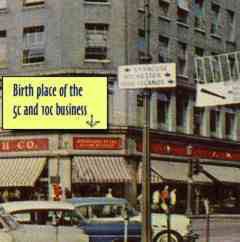
As a memorial to his hero the American Corner was rebuilt and given every modern convenience. In homage to Moore the exterior appearance was preserved in all but one detail. The fascia above the main doors incorporated the words ''birthplace of the 5¢ and 10¢ business" For many years the store served as F.W. Woolworth Co's Principal Office and was one of its most revered locations.
Shortcuts to related content
1900s Gallery
US Expansion:
Founder Biographies
UK beginnings
Financing and setting up the Company
Join us on opening day in Liverpool
Museum Navigation