Working for F. W. Woolworth in the 1960s
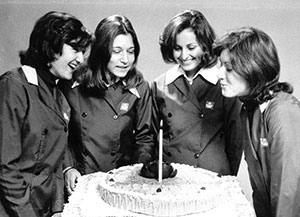
In the 1960s sales assistants got around £6 for a forty hour week, or 15p per hour. Many joined when they left school at age fifteen, Under sixteeens were paid learner's rate of just 7p per hour.
Most employees worked full-time, five and a half days, including three Saturdays a month, and got an afternoon off each week on 'early-closing day'. They were topped up by Saturday staff, many as young as thirteen. A year after joining many asked the local Council for permission to work an hour after school each night and longer in the holidays. A few stores opened in Sundays in the high season at the seaside, but it was illegal for most of the others to open.
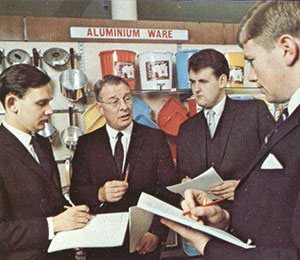
Most stores operated a personal service model, with a colleague on each counter to serve customers and register sales. People were invited to "self-select", picking up the items that they wanted to buy and presenting them to the assistant, a counter at a time. The great majority of purchases were paid for in cash.
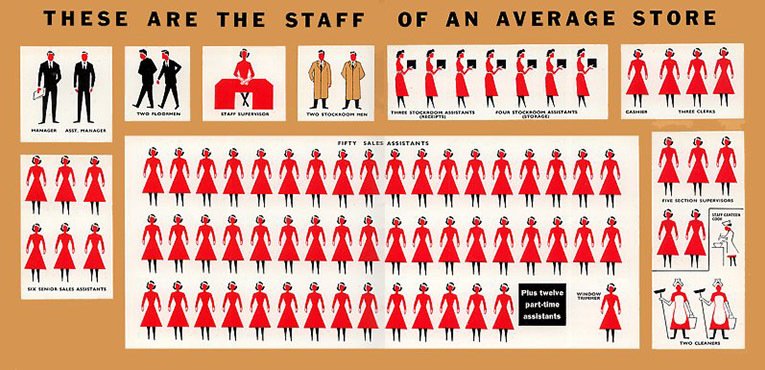
Most branches had more than twice as many employees in 1965, all working longer hours, than they did thirty years later. It seems shocking today, but at the time more than 95% of Managers and Executives were men, even though women had successfully managed many of the stores throughout World War II. The chart below, which was proudly published in 1958's Annual Report looks shocking for depicting all the senior roles as being for men.
The personal service model was labour intensive. Until the late 1960s there was very little automation. The stores did everything by hand:
- The tills didn't add up the value of the shopping; instead staff did this in their heads or by using a 'ready-reckoner table'.
- Each item of merchandise was counted regularly. The stock on hand was recorded in pencil in a stock book.
- One or more senior assistants were appointed to the role of 'merchandiser'. They calculated recommended orders for the Manager.
- The merchandisers used complex fractions to show the stock on hand in boxes and parts of a box, before calculating 'stock commitments', consisting of a sales forecast for each line for the next six weeks. This was also calculated in boxes and fractions.
- For example if the store had 220 Mars Bars in stock and they were supplied in an outer of 144 bar, this was recorded as "1 76/144".
- After the manager had checked and confirmed the merchandiser's recommended orders, they wrote these out in long-hand on a company or supplier order form and retained a carbon copy in the store, ready to record the delivery when it arrived.
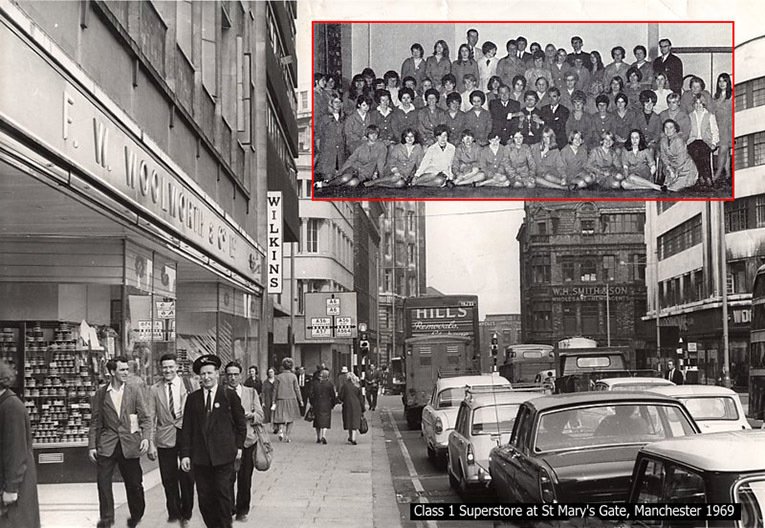
The picture above shows the branch in St Mary's Gate at the end of Deansgate in Manchester City Centre, which was a typical large post-war Woolies. Its predecessor, the original store no. 230 had been called Manchester Arcade, it had opened on 6 August 1926 and had fallen prey to German bombers during a two-night blitz of the City, suffering a direct hit at 9.40 pm on Sunday, 22 December 1940. Reconstruction commenced in 1948, with the new premises opening in 1951. For several years the store stood alone in the centre of a bomb site, before the neighbouring properties were rebuilt. We have superimposed a picture of the full store workforce, which was also taken in 1969. The successful and popular freehold superstore was one of those sacrificed in 1972 to fund the huge cost of decimalisation. The decision to close was particularly ironic, given that questions had been asked in Parliament about how the chain had managed to obtain the steel for the huge girders in its superstructure shortly after World War II despite the City already having a large Woolies nearby on the corner of Oldham Street and Piccadilly. Most of the staff transferred to one of the neighbouring branches at Piccadilly or in Salford. Today part of the premises house a modern branch of Multiyork.
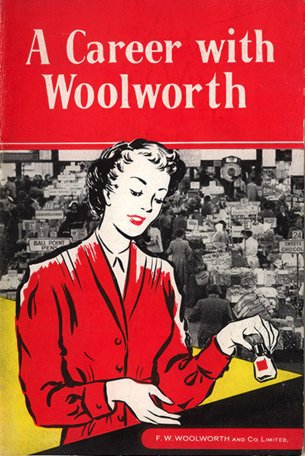
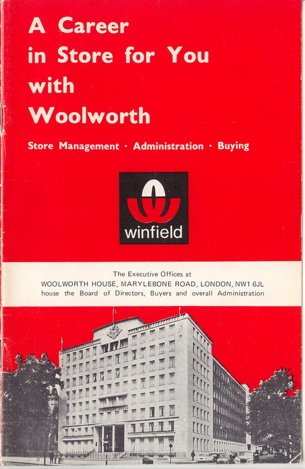
Two booklets were produced, one for store staff and one for Store Management and Executive (Head) Office roles. They set out the opportunities, rules and benefits as well as describing the work.
A Deputy Manager could earn £25 a week (up to four times more than a sales assistant). This was about 60p an hour.
Click either cover to download an Adobe PDF of the full contents.
You can also download a free copy of Adobe Reader.

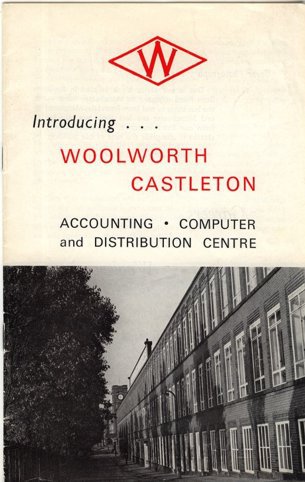
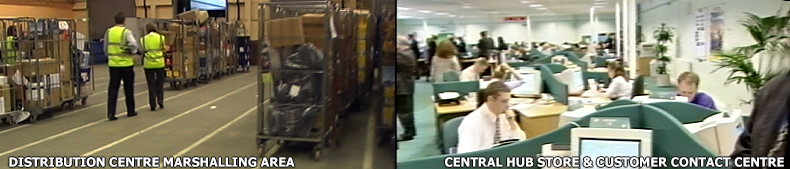
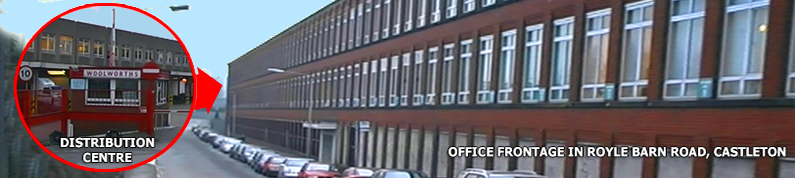
We also have a 60s recruitment brochure for the Central Accounting Office in Castleton, Rochdale, Lancashire. Click its cover to open an Adobe PDF of the full booklet. It includes lots of pictures of the site and explains how each of the main departments, including accounts and finance, systems and the large distribution depot worked. Castleton was one of the last rail-centric distribution centres to open in Britain. The site's railhead received goods from suppliers and was used to despatch goods out to stores across the UK by freight train. During the 1970s it gradually switched to shipping by lorry.
The Castleton workforce celebrated forty years service to the business in 2005; at the time the facility looked set to continue for years to come. It had established itself as the administrative heart of the company and had become a centre of excellence in computing, distribution and human resource management. It also housed an award-winning call centre. Sadly events in 2008 put paid to any plans for a fiftieth birthday at the site. Today much of the site has gone, replaced by new homes. The talent that used to work there has been dispersed far and wide. "Dear God, the very houses seem asleep, and all that mighty heart is lying still."
WORDSWORTH ON WOOLWORTH
2007