Welcome to the Original Virtual Museum - celebrating Woolworths' century at the heart of British High Street Shopping
 -  -  -  -  -
please click a menu button
please click a menu button Original Virtual Museum Home Page please click a menu button The Woolworth value store concept is born in the USA please click a menu button Laying the foundations as the first British Woolworth store opens in Liverpool in November 1909 please click a menu button Woolworths rapidly open forty-four stores in Britain and Ireland before facing a World War please click a menu button Bigger, brighter and bolder Woolworth stores in the Roaring Twenties please click a menu button Woolworths go to amazing lengths to keep all prices under sixpence in the Thirties please click a menu button Bravery and defiance during World War II in Woolworths' finest hour. We pay tribute to the sacrifices made and look behind the scenes please click a menu button Redefining the Woolworth brand for modern times in the 1950s, as prices go up and stores get bigger and bigger please click a menu button Superstores in and out of town, a new own brand and the opening of overseas Commonwealth stores during the 1960s please click a menu button Woolworth struggles to keep up during the rapid inflation and change of the 1970s please click a menu button Woolworth stores in more recent times, covering the period 1980-2008 please click a menu button
please click a menu button please click a menu button please click a menu button please click a menu button please click a menu button please click a menu button please click a menu button please click a menu button please click a menu button please click a menu button please click a menu button
Background to the Original Virtual Museum and copyright information about the contents Origins of the firm's legendary pic'n'mix and a century of chocolate, candy and confectionery in the High Street A century of music and entertainment in the High Street from sheet music and gramophone records to CDs and blu-ray discs A century of toys, games and fun in the High Street stores of F. W. Woolworth A century of fashion in the High Street, from paper patterns and sixpenny knickers to an extensive range of award-winning Ladybird clothing A century of cards, pens, pads and books from the shelves of F. W. Woolworth stores Pots and pans, paint and brushes, bulbs and compost and even toiletries - all in High Street Woolworth stores for much of the twentieth century Woolworths pioneered Christmas decorations in the 19th century and supplied presents for our parents, grandparents and great grandparents from their High Street stores Working conditions and pay rates at Woolworths over a hundred years and some of the people behind the brand-name Our cinema, quiz and picture gallery features Visit the new look 21st century Woolworths on line, on the site operated by Shop Direct Group
please click a menu button please click a menu button please click a menu button please click a menu button please click a menu button please click a menu button please click a menu button please click a menu button please click a menu button please click a menu button please click a menu button

The Toys our parents played with in the Sixties and Seventies


On this page we take a look at some of the toys that our parents played with in the 1960s and 1970s. During the period Woolworth lowered its prices in response to strong competition. During the Sixties the toy range was given a major overhaul, with many new lines, but compared to today's standards most look quite tame. Very few items needed batteries, let alone a mains adaptor. The firm stuck with its tried and tested personal service formula as other retailers moved to self-service. This left most of the branches looking old-fashioned. Most of the photographs on this page were taken for publicity purposes and show the company at its most modern.

A number of Sixties toys celebrated the space programme. These are covered in a separate feature.

The Government's decision to decimalise the currency forced the High Street chain to modernise. Between 1969 and 1975 most of the stores were given a new look. The period also saw the arrival of new ranges of battery-operated and electronic toys, which were sold at discounted prices and were heavily advertised on TV.


A new look Woolworth toy department with a spectacular display of dolls photographed in full colour. The shot shows the Gallowtree Gate branch in Leicester in 1965.The Leicester store (left), was the prototype for a new generation of huge city centre branches. When it opened competitors had started to adopt self-service, but Woolworth stuck to its tried and tested formula with a till among the dolls. Customers would pay for their purchases at each island before moving on, just as they had for half a century in Gallowtree Gate. The new look did include one break with tradition. The single-tiered islands of earlier years were replaced by a shelved and hanging display.

The upgrade of the store heralded a further move up-market. Many of the new items were at higher prices, like the dolls in the foreground of the photograph. Before World War II not a single item in the store cost more than sixpence (2½p); by 1965 some of the branded dolls were fifty-five shillings (£2.55), a hundred-and-one times more. At today's prices the most expensive doll would be £45 or $62. But sixpence still bought a three minute go on the sit-and-ride horse in the background !
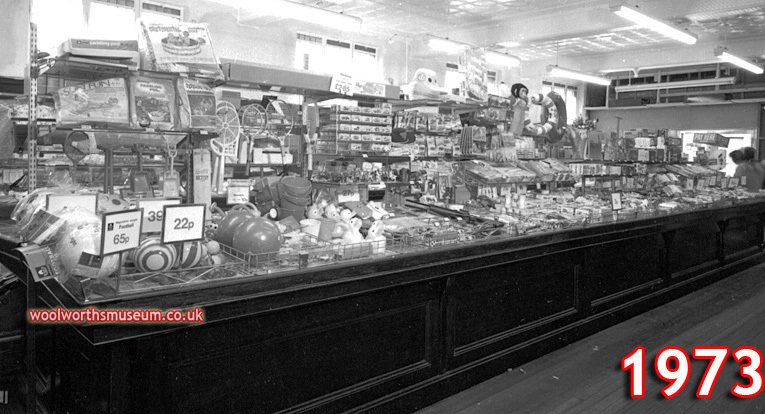
 

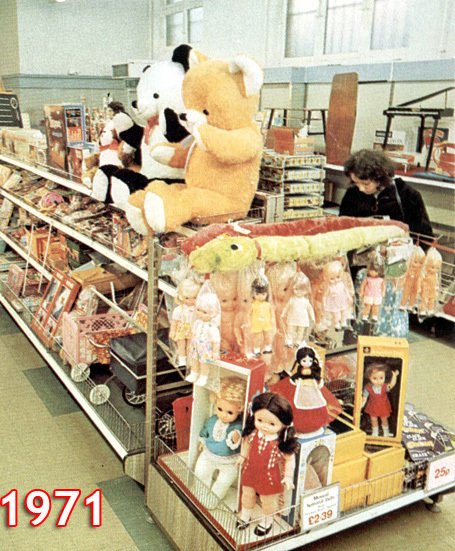
By the early 1970s many smaller Woolworth stores were starting to look quaint and old-fashioned. The picture shows the store at Atherstone, Warwickshire in 1973. While the merchandise had changed, the look and feel of the store had remained frozen in time for the thirty years since World War II. The branch was finally modernised and converted to self-service shortly after this picture was taken.


The toy department in a new look small Woolworth store after 'crash-conversion' to self-service as part of the chain's response to the decimalisation of the British currency in 1971

The picture above shows Atherstone, Warwickshire in 1973, immediately before it was modernised. The store had opened in 1935 and appeared to have been trapped in a time warp ever since. The wooden counters made it hard to display the summer toys, as tennis racquets fought for customers' attention with paddling pools and vinyl footballs. The ramshackle display is reminiscent of Frank Woolworth's original store in Utica, New York in 1879.

The picture on the left shows the contrast of a small store after modernisation. Two hundred Woolies branches were updated each year from 1969 to 1975 as the firm was belatedly forced to move to self-service in order to cope with a government decision to decimalise the country's quaint duo-decimal pounds, shillings and pence currency in February 1971.

One-by-one the older stores closed for a week. The counters were dismantled and cleaned in the stockroom, as painters set to work whitening the ceilings and upper walls. As the paint dried, the wooden floors were scrubbed, sealed and covered over with thermoplastic tiles. Finally the old counters were reassembled in a taller configuration at the back of the store, making way for new shelving and cash desks towards the entrance.

By 1975 every unrefurbished store had adopted the new look, which some commentators described as 'every expense spared' !


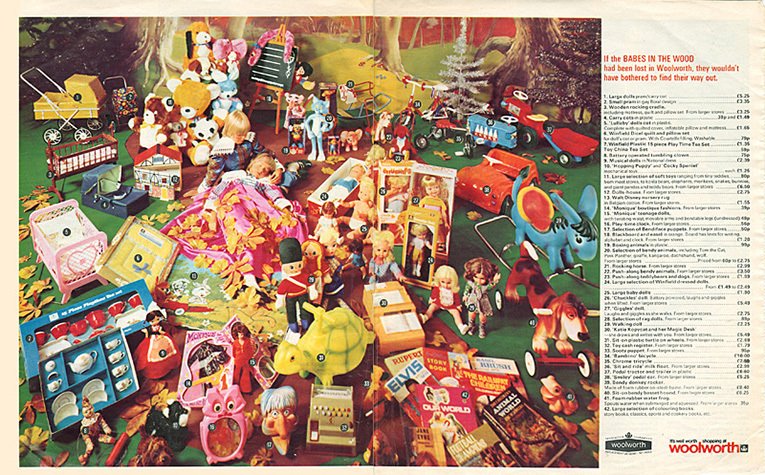
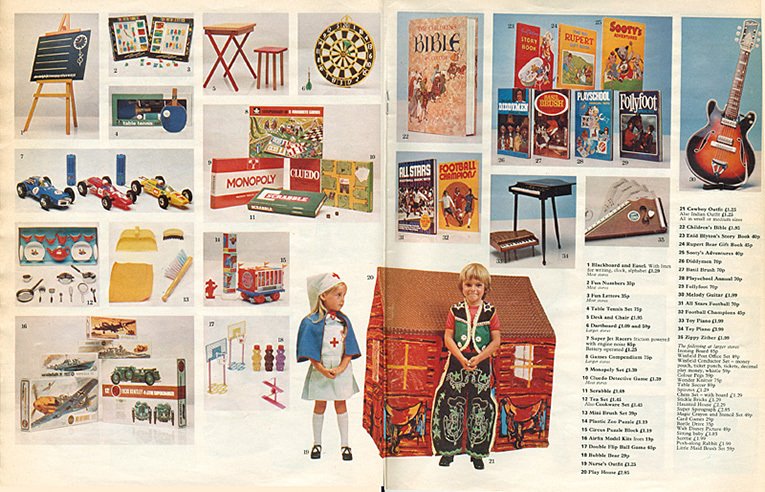
To give a flavour of the toys that children chose in the 1970s, we've picked out some typical pages from the Christmas Catalogues of 1973 and 1975. The brochures were a new idea, reflecting changing buying patterns. If you have a broadband connection you can download a high resolution PDF of the extracts shown below.
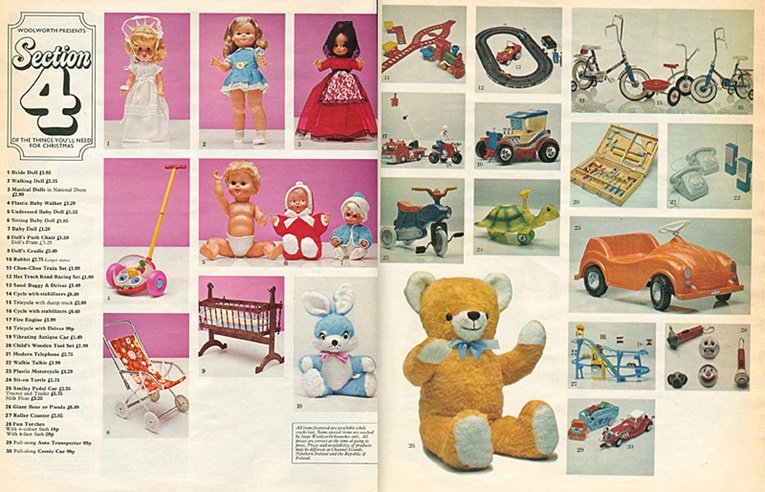
 

The first of two double page spreads in Woolworths first Christmas Catalogue, which was distributed free-of-charge stapled into the centre of the Radio Times, Britain's most popular magazine of the era. Right click and choose 'Save target as...' to save a high resolution PDF version.


The second of two double-page spreads of Toys in Woolworths first Christmas Catalogue, which was stapled into the centre of The Radio Times in November 1973


The 1975 Woolworth Christmas Catalogue, which was distributed with the Radio Times, was inspired by a great British tradition - the pantomime (Oh no it wasn't, oh yes it was.) Oh... just one more thing -"look behind you!"


The second of two double-page spreads of Toys in the 1975 Woolworths Christmas Catalogue


By the late 1970s Toys had begun to play a more important part in the overall Woolworth's offer. The largest stores had enough space to offer more toys than specialist Toy shops, allowing them to experiment. The flagship Oxford Street store in London W1 allocated a sixty foot (18m) run of counter to Lego. There were similar-sized displays of soft toys, Fisher-Price pre-school, sports and leisure, and camping.
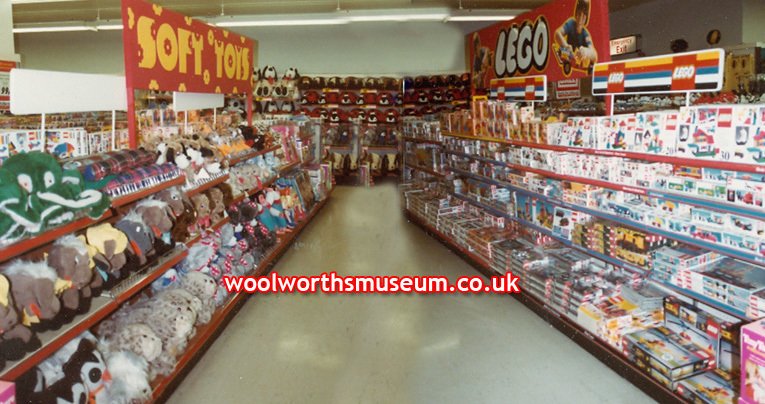
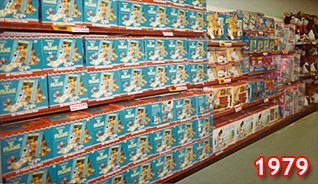
 

Toy displays in Woolworth's flagship store in London's fashionable Oxford Street in the late 1970s (image courtesy of Mr Andrew Hayzelden)


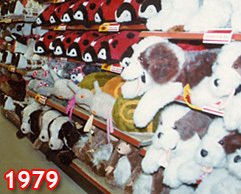
A bold display of Fisher Price toys for pre-schoolers in the flagship Woolworth store in London's Oxford Street, pictured in 1979 (image courtesy of Mr Andrew Hayzelden)Bold displays of soft toys - many of them made in Wales by Lefray Toys - in the flagship Woolworth store in London's Oxford Street in 1979


The toy counters at the flagship store in London's Oxford Street were over 250 feet (80m) long!

They tempted tourists to buy soft toys as gifts. The top sellers included British Bulldogs, Ladybirds, Penguins, Snails and a cuddly octopus.


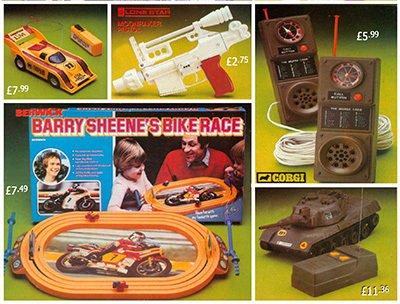
Battery operated and electronic toys were very popular in the late 1970s at Woolworth's

In the late 1970s there was a craze for radio-controlled and electronic toys. They first appeared on the shelves in 1977, and sold out quickly. The following year the range was extended and advertised on television.

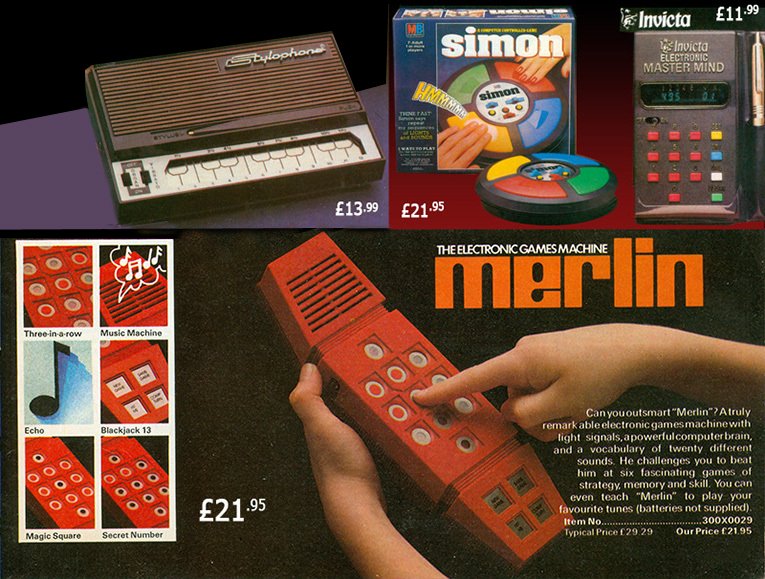
In 1979 electronic gadgets featured strongly in the Christmas television campaign. Two celebrity endorsed products, the Captain Kremen Krenometer promoted by Kenny Everitt, and Rolf Harris's Stylophone became must-have toys, along with an electronic games machine called 'Merlin' (below). The ads also featured Milton Bradley's Simon. Supplier advertising promoted Invicta's Electronic Mastermind and two other MB Games hits, Computer Battleships and Logic 5, which were also available in-store.

The modern age was dawning and Woolworth was determined to be part of it. You can find out more in the Eighties toys feature here in the Original Virtual Museum.


Merlin, the electronic games machine, was a smash hit in 1979, along with Rolf Harris's Stylophone and new electronic toys from Milton Bradley and Invicta Toys. Many of the items were four times more expensive than a Board Game of the era at over £20.

"Sell a toy, spread some joy"
Frank W. Woolworth - letter to stores. November 1909.
 -  -  -


Fast links to Original Virtual Museum exhibits

Wonders from Woolies

What our great grandparents used to buy   Got to believe that it's magic

The first character merchandise    In and out the windows    The Lion and Albert

There's a war on   Fifty years ago    Mum and dad's toys    The race for space

Cool for School   Woolies by Woolies at Woolies   Eighties and Nineties Toys   

Wooly and Worth    Kids and Celebrations    Century of Toys Video


Bonus Items - The History of Chad Valley

Although now owned by the Argos parent Home Retail Group, Chad Valley was
rescued by Woolworths and a key part of the firm's offer for 21 years

Toys for Toffs    TV changes everything


Museum Navigation

Toys Gallery Home     Home Page    Interactive


If you have enjoyed our Virtual Museum website, why not check out our complete history of Woolworths in a 194 page, richly illustrated paperback book?  A Sixpenny Romance is just £10.99, with free delivery in our on-line shop.
The special DVD, the Wonder of Advertising, is now available in our on-line shop for £7.50 in our on-line shop. A fully illustrated 194 page history of Woolworths, or a selection of professionally authored DVDs in our on-line shop