
A Century of Thrift
The Woolworth Home Economy Department
What do you do when something wears out or gets broken? Perhaps you throw it away and buy another, or maybe you let your fingers do the walking and call someone in to fix it. But more than 130 years ago Frank Woolworth worked out that there was another way - to repair the item yourself, saving money and avoiding waste. From his first day's trading he offered the tools and spares that people would need to 'make do and mend', building a reputation as the 'knick knack shop' with hard to find items. Despite many changes over a century of trading in the High Street, these items remained a mainstay of the Woolies range for five generations, surviving the challenges of world wars, the rise of the Internet and the growth of out-of-town DIY stores and supermarkets, before succumbing to waste and excess as it lost its way.
Among the retailer's make do and mend ranges were:
- stick on soles and heels for shoes (virtually the only store to sell these)
- haberdashery, including sewing, buttons, patches and wundaweb
- hardware and basic tools, small packs of tacks, nails and screws and glue, repair tape, hooks and castors
- tins of paint, both large and small, paint rollers and a sets of brushes for less than others charged for one on its own
- the chain also sold a wide selection of electrical fittings and bulbs. This range has its own page
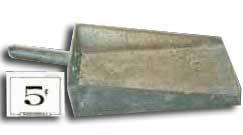
Our story begins on the evening of Friday 21 February 1879, as Woolworth prepared his 'Great Five Cent Store' in Bleeker Street, Utica. Someone knocked and asked if they could buy a dustpan. The proprietor sold the pan he was using to clean up, losing 20¢ on the transaction. Spotting the demand, he added hardware and tools which soon became a staple range. Dustpan and brush sets are still sold by F.W. Woolworth GMBH in Germany today and remained a popular favourite in the USA until 1997 and in the UK until January 2009, when they closed.
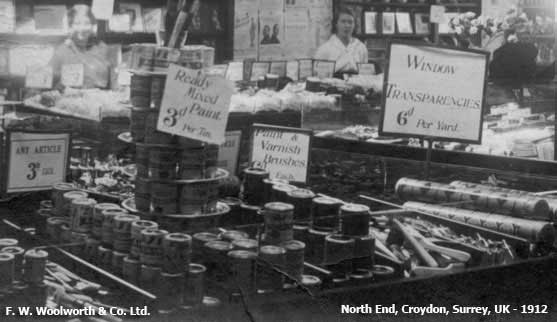
The first British Woolworth store built on the success of its American parent's Home Economy Department. By 1909 the 5&10¢ had 500 stores, stocking lots of practical everyday items. The UK Buyers chose similar lines from local factories and were able to offer them at even lower prices.
In Liverpool 500 products made up a selection of 'Notions'. After feedback this the name was anglicized to 'Home Economy Dept.'. When a branch opened in Croydon in 1912 shoppers emptied the shelves of paint, brushes and tools on the first day.
To complement the home repair lines, there were also lots of items to help make and repair your own clothes, including wool, needles and patterns. These are featured in our Clothes Gallery.
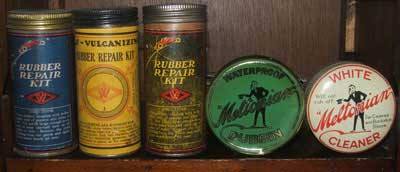
The Boot Economy section carried Meltonian-branded dubbing, polish and shoe whitener continuously from 1909 until 2003, when leaders foolishly gave it "the boot".

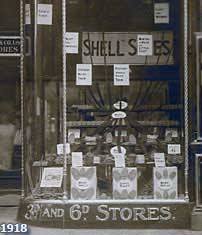
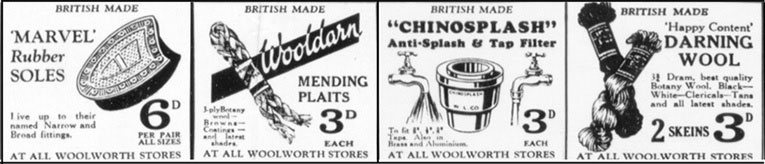
Initially high sales of shoe polish had inspired the British Buyer to create the distinct Boot Economy section. He put the strong glues and durable that had been developed during the Great War to a less destructive use, getting a factory to shape what he called "shells" to affix over worn soles, along with new heels in a variety of shapes. Each pair was bundled with a small tube of extra-sticky glue and a disposable trimming blade. For sixpence shoppers could revamp their existing shoes without buying a new pair.
As well as eighteen types of stick-on soles and heels, to complete his range he also sourced a selection of shoe laces, as well as heel grips, lining inner soles and blakeys, which were a wide metal pin that could be pushed into the heel to reduce wear. The Toiletries Department also played its part, with small packs of foot powder and heel balm for threepence.
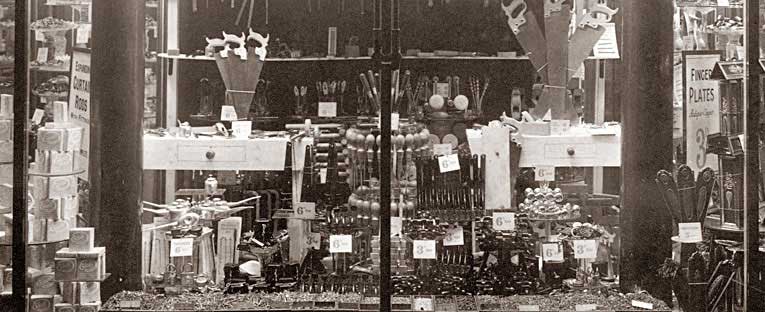
By 1930 the chain had grown to 375 outlets right across the United Kingdom and the Irish Free State. Its huge buying power allowed it to offer a comprehensive range of hardware and tools for sixpence or less. As the selection grew this range also got its own name, immortalised in gold lettering on a maroon sandblasted glass sign as "Carpenters and Engineers Tools" and later the still more boastful "Cabinet Makers' and Builders' Hardware". The bravado acknowledged that many of the well-made budget tools were sold to cash-strapped professional tradesmen before DIY became fashionable. The breadth of range was captured for posterity in a window display at London Road, Liverpool in 1931 by the legendary architectural photographer Stewart Bale, who was regularly commissioned by the Company.
During World War II many factories were commandeered to make armaments, meaning few new items got to the shops. Instead the government promoted 'make do and mend'. Woolworth was perfectly placed to respond. As rationing forced people to re-use and recycle, thousands went to Woolworth's for the tools and knick-knacks required to adapt clothes, fix up damaged furniture and tape down thread-bare carpets. Few even noticed when the prices began to rise, after inflation forced the stores to breach their longstanding sixpenny maximum price. Without the restriction, when peace returned the range began to grow rapidly. It seemed that customers had got the bug for fixing things themselves, and were willing to tackle more challenging projects.
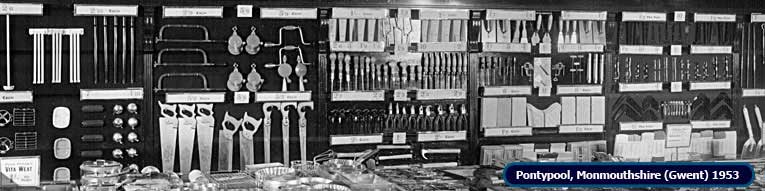
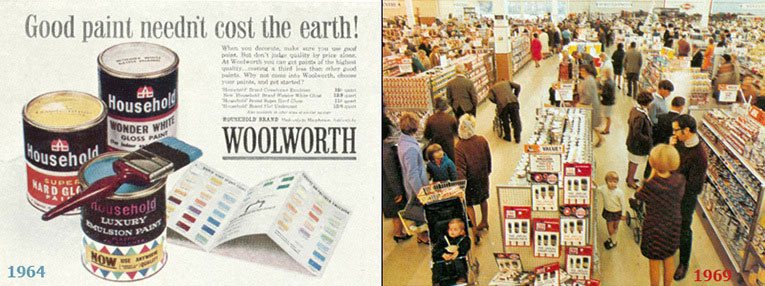
Larger traditional displays like the one at Pontypool (pictured above, with special thanks to Reg and Ray Gallanders) were just the start. As new superstores rose from the ashes of those destroyed in the Blitz, in a pioneering move they included a comprehensive 'do it yourself' shop. A new generation of Buyers had spotted that shoppers were becoming more aspirational, wanting to improve their homes and living conditions as the country returned to rosperity. They weren't prepared to put up with the squalor and discomfort of earlier years. When a new store opened in the Broadgate Shopping Centre, it was very different from the Smithford Street branch that had been annihilated in the Coventry blitz. In the Thirties it had stocked just white and magnolia 'distemper' oil-based paint for walls and ceilings. Now there was a rainbow of colours of emulsion paint, with co-ordinated shades of gloss for the woodwork, as well as wallpaper and a huge display of polystyrene tiles, which were considered the height of fashion.
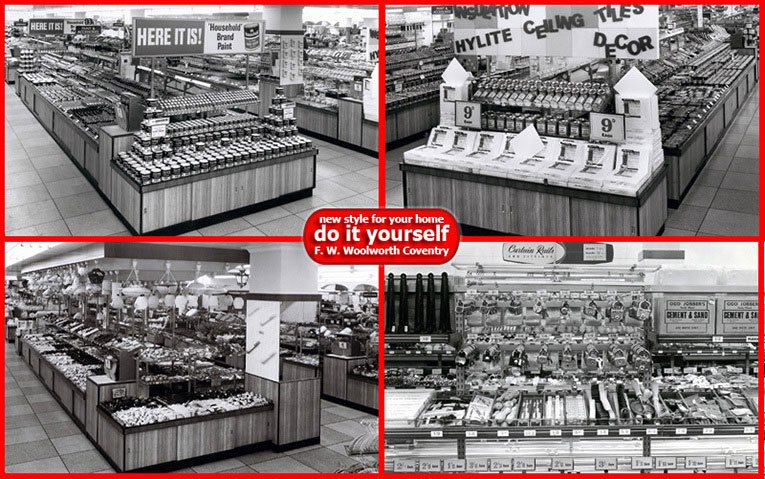
The new ranges proved popular with the public and were soon offered nationally. During the 1950s the Buyer worked with the long-serving supplier Donald Macpherson and Company to update the paint offer. They gave the own-label range a distinctive name as 'Household Brand' and used bold signage and a carefully targeted advertising campaign to build it to become the UK market leader. The dominant share was retained until the 1980s, morphing into 'Cover Plus' as the High Street stores faced new competition from their one-time subsidiary B&Q and other out-of-town DIY stores.
Back in the 1950s and 1960s Woolworth had shaped DIY as a new market, and had used its national presence to engage the public. In the late 1960s many dads found power tools from the latest addition to the range in their Christmas Stockings, many of them bearing the chain's new Winfield label. Most had been bought in the basements of City Centre branches, with the remainder coming from a new generation of out-of-town Woolco stores. It was the success of these pioneering giants with big car parks, which began to appear on brown-field sites on ring roads around the major conurbations, that inspired Woolworth to go further. After deciding to launch a separate DIY chain, it bought B&Q and began to relocate its stores from in-town former cinema premises to the out-of-town supercentres that most people remember from the Eighties and Nineties.
The story began in 1979 when Geoffrey Rodgers, the Chairman asked his Property Department to find appropriate sites to build stores for a new DIY Division. The search pinpointed a rapidly-growing, upstart chain which did not have enough cash to achieve its full potential, recommending it as a possible acquisition. The Chairman agreed and began negotiations with B&Q under a veil of secrecy. When a deal was struck and announced on 1 September 1980, it was a bolt from the blue for both employees and media commentators. They noted that Woolworth had paid a hefty premium to acquire an established business and had financed the purchase by selling several of its largest freehold stores in Central London.

B&Q's founder David Quayle joined the Woolworth Board. At the time of the acquisition his co-founder Richard Block had already left to pursue other interests, leaving just his initial on the fascia.
The bold move drew analysts' attention to Woolworth. Several called it an "ailing giant" and wondered whether its conservative management would have the resolve necessary to capitalize on the purchase. It also attracted attention from a more unwelcome quarter. The deal had unwittingly revealed the hidden value of the High Street chain's extensive portfolio of freehold property, as well as B&Q's potential to dominate a rapidly expanding market. It inspired a speculative takeover bid for the UK Woolworth in 1982, when the hunter became the hunted, as the American parent company was persuaded to sell its controlling interest to a consortium of investors.
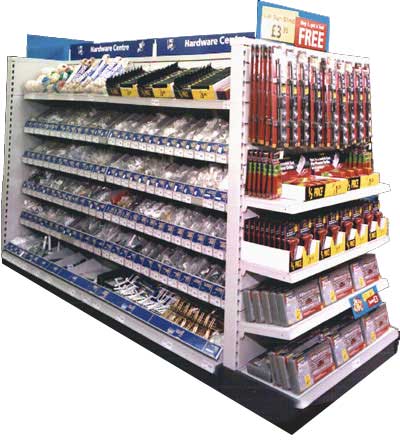
The new owners made radical changes to the formula. A new DIY Division was operated separately, with the majority of power tools and larger items stocked only at B&Q. Most of the largest City centre Woolworth superstores were closed and sold to finance expansion out-of-town. Meanwhile the High Street stores were given a makeover. The new range concentrated on 'home repair' with fewer tools and a more fashionable range of paints, brushes and interior decor, including the popular Cover Plus paint from veteran Donald Macpherson, which had supplied the stores for 75 years.
Shoe goods and haberdashery were given an overhaul, which boosted sales. Enhancements to bathroomware, curtain track and accessories were equally successful. The high margin ranges became mainstays of 'Operation Focus', forming a competitively-priced, convenient solution in the High Street.
Over time the formula was adapted. In the 1990s the emergence of Wilkinsons prompted soul-searching in the Board Room, where Directors feared they had moved too far up-market and were being undercut on price. Energy was devoted to clever re-engineering of the products to maintain quality while allowing them to be made more cheaply, with the savings reflected in lower prices on many lines. A lot of duplication was eliminated in a bid to drive more volume through a smaller number of lines, and to avoid unnecessary overlap with B&Q. Sales stabilized and began to grow again through strong sales promotions in the January Sale and at Easter, the traditional peak time for DIY projects.
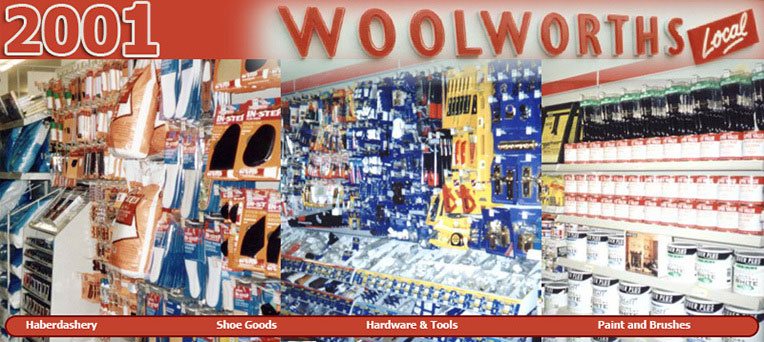
In 1999 Kingfisher launched new out-of-town superstores as a showcase for their British retail brands. They carried the full Woolworths range, electricals from Comet, DIY from B&Q and Toiletries and Cosmetics from Superdrug. Woolworths was asked to manage the venture, which was baptized Big W, and to plan for a chain of up to fifty outlets, each generating up to £½ million of sales per week.
As the plan took shape, the parent company worked on a secret plan to address the major product groups that none of its operating companies stocked, Adult Clothing and Food. Soon after announcing the Big W venture, it stunned the City with news of an agreed deal to merge with Asda, which was to be put to shareholders. Sadly, despite overwhelming support from investors in both companies, at the eleventh hour Asda dropped out of the deal, revealing that its Directors had been in parallel talks with the huge American Walmart corporation. This holed Big W below the waterline before it even opened. Soon investors and analysts began to challenge Kingfisher's wider strategy, demanding that the Group be broken up. After months of wrangling Woolworths was demerged in the Summer of 2001. It had to work out how to fill the huge Big W stores without its former sister companies.
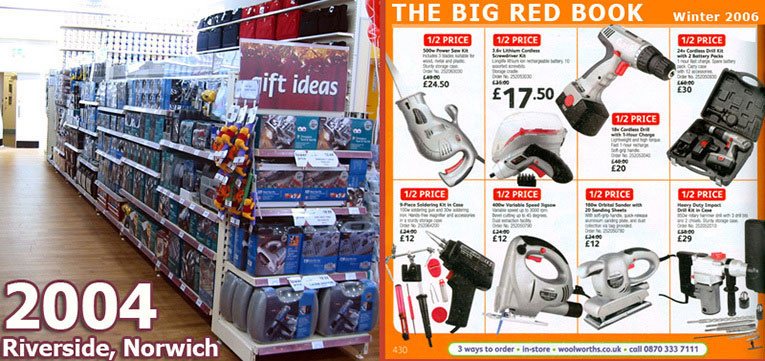
The new CEO, Trevor Bish-Jones, decided to pursue a 'Kids and Celebrations Strategy', devoting most space in the stores to Ladybird Children's Clothing, Chad Valley and branded toys, 'fun learning', greetings cards and a large range of music and video. The long-term intention was to phase out the 'back departments', which would have eliminated DIY and Home Maintenance altogether. The concept was tested briefly in Midland Road, Bedford with mixed results. The first stage was to scale the range back, leaving mainly higher priced items that were suitable for gifts, like own-label power tools that could be cheaply made in the Far East. The popular displays of shoe goods and haberdashery were condensed into a single bay, alongside similarly sized selections of paint accessories, tools and knick-knacks. Most controversially, Macphersons paints were dropped after ninety years and replaced by a small branded range. This signalled a move to dedicate the stores to Mums and Kids, with little for dad or older customers. Wilkinsons had won the battle without firing a shot.
Ultimately the new strategy failed. The sales uplift and margins on the 'Kids and Celebrations' ranges were insufficient to make up for the shortfall from the space-reduction and lost traffic when the Home ranges were cut back. The last store closed its doors in January 2009. Today shoppers have to go to Germany or Mexico to buy hardware and tools from Woolworths.
Shortcuts to related Home, Kitchen and Garden content
The History of China and Glass at Woolworth
Thrift and economy - DIY at FWW
Blooming good - seeds, bulbs and plants