Woolworths Group PLC
emerges in 2001

Kingfisher does the splits, loading the demerged Group with debt
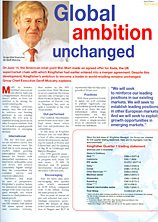
The Kingfisher CEO Sir Geoffrey Mulcahy made such a good case for a merger with Asda, that the eleventh hour collapse of the deal gave everyone the jitters. He sought to reassure the investors and staff that the Group had other options, and its ambition to become a global player remained unchanged. A full page article, written by the top man, was included in the June edition of Kingfisher Manager magazine.
But, despite the bravado, pressure was buildng from investors, whipped into a frenzy by adverse media comment. Editors suggested the long-serving CEO was past his sell-by date; he had lost his golden touch after eighteen years at the helm of the business. They argued that Kingfisher had become too large, unfocused and therefore unmanageable, undermining Mulcahy's 'bigger the better' mantra. They recommended following best practice by trimming down to focus on 'core activities'. The CEO resisted.
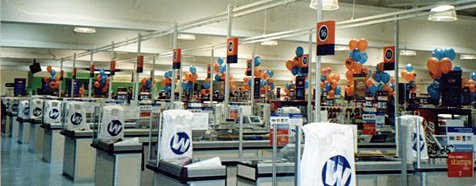
Mulcahy was able to cite good early results from the new Big W stores. Two had opened North of the border in 1999. Work was in hand to open the next two, in Imperial Park, Bristol, and on the site of a former Morrisons in Bradford, West Yorkshire.
He was please to report that sales in the first stores were well ahead of target, with store car parks full to overflowing at weekends.
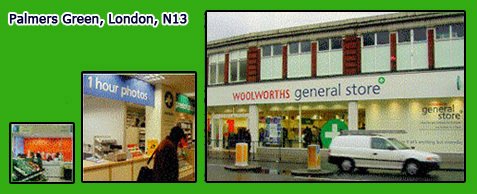
General Store was also blossoming. It was the brainchild of the former Superdrug's Marketing Director, Stephen Round, its first MD.
The convenience drugstore aimed to match the success of the US giant, Walgreen. It was a hybrid with the key Woolworths and Superdrug ranges under one roof, along with a food and wine selection from Booker Distribution.
A number of Woolworths and Superdrug stores were identified to 'join forces' to boost returns.
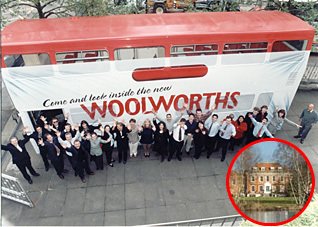
By Summer of 2000 there were twenty General Stores, eighteen of which had replaced a traditional Woolworths. Early results were encouraging.
Progress was interrupted in March 2001, when the media turned on Kingfisher after a severe slow-down in profits in Continental Europe.
The press demands to split the Group continued for six months before Mulcahy gave in on 19 September He called his hundred top managers to a briefing at the Stoke Poges Conference Centre. He explained that he had reluctantly concluded that a demerger would be the best option for everyone. 'GM' (General Merchandise) would split from Kingfisher. It would be a substantial new company with its own CEO and a £3bn turnover.
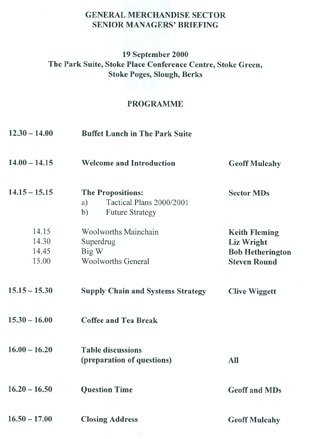
Mulcahy assured a sceptical audience that 'GM plc' had good prospects. It would leave on a firm financial footing and would no longer compete for funds with B&Q, Comet and the expansion overseas. The new Group would be substantial, with a turnover in excess of £3 billion generating annual profit of almost £200m.
Kingfisher had lined up a first-class management to lead the demerged Group. This would reunite the High Street group with an old friend, Martin Toogood, who would step up from his role as CEO at B&Q to become Chairman. Top financier Philip Rowley from Kingfisher would be the Group's first Financial Director.
After the session Mulcahy was able to announce the final piece of the jigsaw. He had persuaded another ex-Woolworths Director, Jim Glover, to be the first CEO.
During questions and answers at the end of the session, Mulcahy was asked for further information about the financing of 'GM plc'. He was candid, explaining that Kingfisher owned the freeholds of four hundred of the High Street stores, and had recently acquired the freeholds of the Woolworths and Superdrug Head Offices and their principal depots. Chartwell Land would give these assets to the new Group too make it financially secure.
In the months that followed the meeting, Kingfisher struggled with the details of the split. It became clear that a demerger would not raise any money for the parent. Options for an outright sale to another retailer or a venture capital group were explored. When no purchaser emerged for the whole Group, Superdrug was sold to the Dutch retailer, Kruidvat. This radically changed the dynamics of the demerged company. Shortly afterwards it emerged that Toogood, Rowley and Glover had withdrawn and were no longer involved.
The news left the remaining general merchandise companies in limbo. As a search started for new executives to lead the demerger process, the companies continued with their existing strategies. General Store continued its programme of openings, buying further pharmacy licences and photolabs. The expansion of Big W also continued at pace.
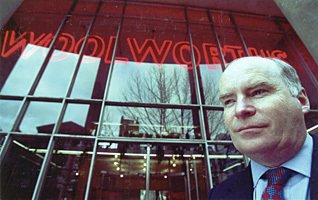
To maintain the demerger timetable, a big name was required. The former Railtrack boss Gerald Corbett became Chairman Designate. He needed to rebuild his career after the well publicised problems at the railway infrastructure giant, and brought extensive top-flight experience, including a spell in the retail sector as Financial Controller at Dixons Stores Group.
Corbett proved a thorn in the side of Kingfisher. He fought hard to set the newly-named Woolworths Group plc off on a good footing. A public war of words broke out after backchat from Kingfisher middle managers leaked to the press. Most pundits took Corbett's side, considering the Group lucky to attract such a heavyweight, particularly alongside the respected Christopher Rogers from Comet as his Finance Director.
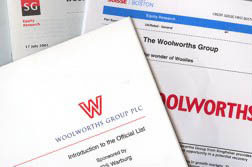
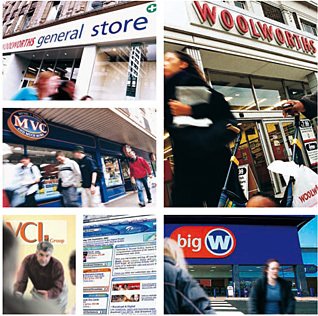
Leading brokers published demerger prospectuses to introduce the new listing. These emphasized the potential of Big W and General Store, and highlighted the success of a Woolworths value initiative and its new Direct catalogue proposition. They reported that the group had a strong management, with three seasoned MDs, Keith Fleming in the High Street, Bob Hetherington in charge of Big W and Stephen Round heading the General Store project, as well as a big name Retail Director in Steve Lewis.
Very little commentary was provided about the smaller companies in the new Group. The 88 MVC music and video stores, wholesaler Entertainment UK, music publishers VCI Group, and web experts Streets On Line got just a line or two each.
The small print was of more concern to canny observers. Kingfisher's goal from the demerger was to finance its option to buy full control of the French DIY chain Castorama and, if possible, also reduce its own £1.8bn of debts. The £300m sale of Superdrug was deemed insufficient.
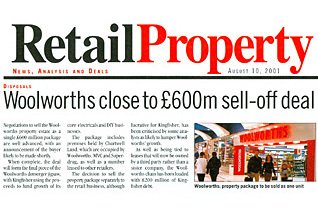
As a straight demerger would not raise any funds, it was decided that the all of the remaining freehold properties would be sold. To maximise the value of these assets, a lock-in guaranteed rental income to landlords for a thirty year period. Rents would be reassessed on a rolling five-year cycle, on an upwards only basis. Woolworths Group was also loaded with £200m of debt, which was said to reflect the value of its stock and fixed assets. The moves raised a further £800m.
Writing in London's Evening Standard on 2 August 2001, the respected journalist Anthony Hilton, who had previously been an admirer of Kingfisher and Sir Geoffrey Mulcahy, was sceptical about the new Group's prospects:
Flying solo has its risks
Sir Geoff has an affection for Woolies and claims it has potential for growth, but it is hard to see Woolworths prospering. Not only does it take on £200m of Kingfisher debt in the demerger but a large number of its properties have been sold, with Kingfisher keeping the £600m raised.
Sir Geoff talks enthusiastically of the new concepts for general retailers and of its market leadership in toys, entertainment and confectionery, which gives it a base on which to operate as a discount merchandiser for all the family. But there are just too many predators and competitors. Its market-leading positions do not seem enough when all the trends in retailing seem to be going towards the specialists.
Kingfisher, in contrast, looks in good shape. The demerger has improved the balance sheet by £800m, which on top of the £300m raised a few weeks ago when Superdrug was sold and £200m of property sales in the pipeline, adds up to a £1.3bn reduction in the group's £1.8 bn of indebtedness.
When Woolworths Group plc listed in August 2001, the demerger process had taken almost a year. It had destabilised each of the operating companies, and had prompted a wave of resignations, from people keen to remain with Kingfisher or determined to work for an FTSE 100 rather than a 250 company.
Whatever the rights and wrongs of the demerger process, the acrimony had to be forgotten and the new Group needed to find its feet and move forward.
To everyone's relief, the 25p shares, which had traded at 22p in the grey market before the launch, rocketed to 29p on opening day and remained buoyant. In spite of dire predictions, institutional investors held faith with Woolworths, even after a warning to expect large exceptional items and a slow road to recovery.
The Chairman Gerald Corbett and FD Christopher Rogers promised that the new Group was in safe hands with good long-term prospects. They would introduce 'the perfect CEO' very shortly.
Shortcuts to related content
2000s Gallery
New values and a new direction
Visit a new-look Woolworths Out-of-Town, as it opened in 2005
Navigation