The ill-fated "Merger of Value Champions"
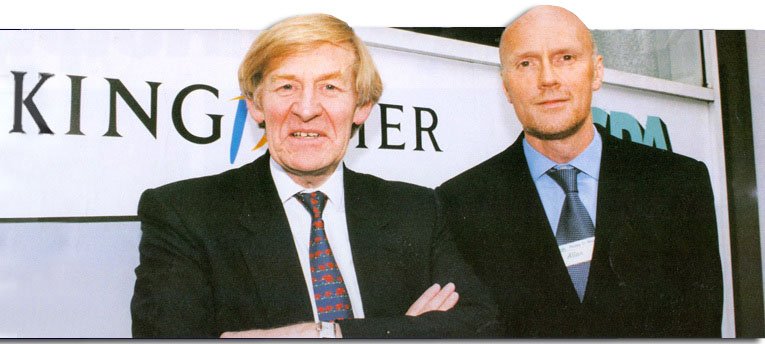
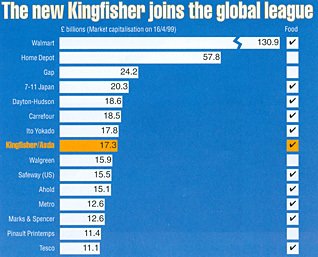
In the Spring of 1999, Kingfisher CEO Sir Geoffrey Mulcahy and Asda CEO Allan Leighton stunned the City by announcing plans for a 'Merger of Value Champions' that would catapult an enlarged Kingfisher into the worldwide Retail Superleague and would give Asda access to the funds they needed to continue to grow. The Grocer had enjoyed considerable success, expanding rapidly and establishing a reputation for offering good service and very competitive prices. Of all the supermarkets, Asda had led the way in extending beyond grocery into General Merchandise. For example they had built their 'George' Clothing Brand to £500m a year. What was more a number of senior executives at Asda had worked at Kingfisher earlier in their careers. Mulcahy and Leighton were confident that the two firms were culturally compatible, they told reporters.
The investor prospectus was unusual. Unlike most merger documents, the emphasis was on growth and potential rather than savings. The document highlighted the size of the enlarged group's markets and how the new synergies would help all of the operating companies to increase their shares. It explained that, by working together:
- Asda could draw on Kingfisher's international expertise as substantially the largest British retailer operating overseas
- Woolworths City stores could sell George clothing, and potentially offer grocery in out-of-town locations
- Asda stores could offer Ladybird clothing, Pic'n'Mix, Home and Kitchen ranges from Woolies, alongside DIY and tools from B&Q, toiletries from Superdrug, electricals from Comet and Darty and could source Music and Video from Entertainment UK - all driving up buying volumes and allowing yet better value to the customer
- a number of store sites could be redeveloped to accommodate both retailers
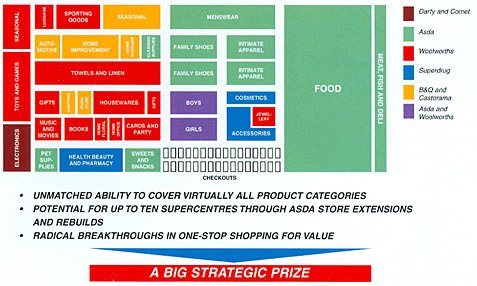
To help customers and colleagues to understand the potential of the new business, example layouts were drawn showing how a new generation of 'supercentres' offering a one-stop shop of both Groceries and General Merchandise might work (right), highlighting which operating company might source each of the major ranges to be carried.
 Alan Leighton had built a strong reputation at Asda for keeping colleagues informed about developments, braving up to bad news when required, but mainly sharing rewards and recognising success and achievements. His motivational skills would be crucial to setting the new Division on the right course for the third millennium.
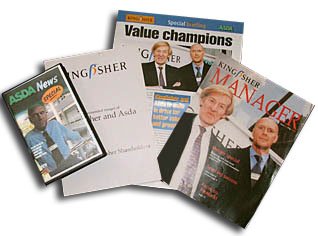
Leighton quickly set to work getting his staff on side, alongside work to evangelise the merger to investors. An internal Asda News video was produced. In it the CEO stood on a staircase inside Asda's HQ in Leeds and simply chatted, without notes, to his workforce. Every employee saw the film during April 1999. Kingfisher was rather slower off the mark. It is revealing that, when it came in the middle of May, Kingfisher Manager magazine was Vol 1 Edition 1.
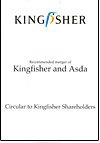
Both companies needed approval from their shareholders. Each developed a Prospectus and sent it out for review ahead of an Extraordinary General Meeting in June 1999. The document set out in detail how the enlarged group would work, its market shares, types of store and the potential synergies. Shareholders were asked to vote 'yes' or 'no'. When the results were counted, the response was overwhelmingly positive. Over 90% of those who responded favoured the deal. It appeared that everything was on track.
But, at the eleventh hour, the Asda Chairman Archie Norman stepped in. He dropped a bombshell. The world's number one retailer, Walmart, had approached the Board late-in-the-day with an offer to buy the Asda, promising to give them the latitude and investment needed to progress their plans, and backing it up with a buying power that was second-to-none. His Board had concluded that this offer was better for shareholders and therefore had agreed to merge with Walmart. As a result Asda was withdrawing from the deal with Kingfisher with immediate effect.
The Kingfisher Board had little choice but to put on a brave face as they reassured investors. City Analysts, who were initially sympathetic, soon turned their attention to the high out-of-pocket costs incurred in the abortive deal. Editorials asked whether Sir Geoffrey had lost his golden touch, suggesting that perhaps Kingfisher had become too large and complex and had lost direction. Before long they were demanding that the Group should trim down to its core operations, suggesting that it should focus on DIY. In the simple headline of one red top newspaper, 'it Asda be somebody's fault'.
Ten years later, meeting with the writer at his club in Pall Mall, Sir Geoffrey remained bitter about the Asda affair. In retrospect he believed that the decision by Asda Board's had set the changes in motion that ultimately led to the closure of Woolworths' High Street stores. He acknowledged that it was a difficult choice for Asda and still believed that they chose the wrong merger. It is said that those who were Asda Directors at the time now have some regrets about the decision. But what is done is done.
Shortcuts to related content
1990s Gallery
Limited Story Stores with more specialist ranges
A Standalone Ladybird store - picture gallery
Spectacular £100m profits in 1997
American Woolworth "retires" after 118 years
Keith The Alien brand advertising character
Site Navigation