Welcome to the Original Virtual Museum - celebrating Woolworths' century at the heart of British High Street Shopping
 -  -  -  -  -
please click a menu button
please click a menu button Original Virtual Museum Home Page please click a menu button The Woolworth value store concept is born in the USA please click a menu button Laying the foundations as the first British Woolworth store opens in Liverpool in November 1909 please click a menu button Woolworths rapidly open forty-four stores in Britain and Ireland before facing a World War please click a menu button Bigger, brighter and bolder Woolworth stores in the Roaring Twenties please click a menu button Woolworths go to amazing lengths to keep all prices under sixpence in the Thirties please click a menu button Bravery and defiance during World War II in Woolworths' finest hour. We pay tribute to the sacrifices made and look behind the scenes please click a menu button Redefining the Woolworth brand for modern times in the 1950s, as prices go up and stores get bigger and bigger please click a menu button Superstores in and out of town, a new own brand and the opening of overseas Commonwealth stores during the 1960s please click a menu button Woolworth struggles to keep up during the rapid inflation and change of the 1970s please click a menu button Woolworth stores in more recent times, covering the period 1980-2008 please click a menu button
please click a menu button please click a menu button please click a menu button please click a menu button please click a menu button please click a menu button please click a menu button please click a menu button please click a menu button please click a menu button please click a menu button
Background to the Original Virtual Museum and copyright information about the contents Origins of the firm's legendary pic'n'mix and a century of chocolate, candy and confectionery in the High Street A century of music and entertainment in the High Street from sheet music and gramophone records to CDs and blu-ray discs A century of toys, games and fun in the High Street stores of F. W. Woolworth A century of fashion in the High Street, from paper patterns and sixpenny knickers to an extensive range of award-winning Ladybird clothing A century of cards, pens, pads and books from the shelves of F. W. Woolworth stores Pots and pans, paint and brushes, bulbs and compost and even toiletries - all in High Street Woolworth stores for much of the twentieth century Woolworths pioneered Christmas decorations in the 19th century and supplied presents for our parents, grandparents and great grandparents from their High Street stores Working conditions and pay rates at Woolworths over a hundred years and some of the people behind the brand-name Our cinema, quiz and picture gallery features Visit the new look 21st century Woolworths on line, on the site operated by Shop Direct Group
please click a menu button please click a menu button please click a menu button please click a menu button please click a menu button please click a menu button please click a menu button please click a menu button please click a menu button please click a menu button please click a menu button

The wonder of ... advertising
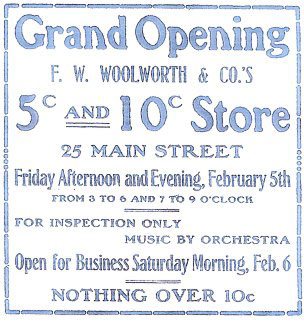
The only type of advertising endorsed by the founder Frank W. Woolworth - advertisements to promote the opening of new stores.  (With special thanks to John Compton)


In the early days of the F. W. Woolworth chains in North America and the United Kingdom the only thing the firm advertised regularly was new store openings. The founder, Frank Winfield Woolworth, said "Dress your windows twice a week with big leaders with prices attached. That  is our advertising".

There were occasional exceptions, like the launch of the chain's own label cottons and sewing notions, and bullseye rings during the Great War. But these were rare.

It was only in the 1950s that the company first dabbled with serious advertising, in response to increased competition. A major press campaign in the USA generated good results. This was supplemented by 'The Woolworth Hour' on CBS Radio. Initially the idea was not adopted in the UK where sales and profit were booming.

In 1959, with encouragement from New York, it was agreed that the subsidiary would launch a wall-to-wall press campaign and its first tv commercials to promote its year-long Golden Jubilee event. Afterwards the Board concluded that print had been most effective. They continued to use the medium throughout the Sixties.


Then in November 1971 there was a new departure.  A twenty page Christmas Catalogue was stapled into the Radio Times, which was the nation's largest circulation magazine. This showed the extensive range of toys, gifts and electrical appliances. Woolworth was the first company to distribute its catalogue to a wide audience in this way. As the idea developed, the best products could be ordered by mail using a new "Woolworth by Post" service. The firm went on to publish a Christmas Catalogue every Christmas until 2008, but dropped the mail order idea in 1982, restoring it for a spell from 1998-2001 and, as The Big Red Book, from 2006-2008.

In 1976 another innovation brought money off coupons in the catalogues, which encouraged shoppers to buy early. The idea stimulated the sale of more than 100,000 electronic organs in 1976 and became regular feature over the following 32 years.
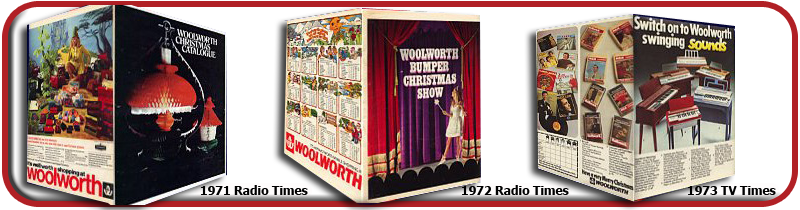
 

Woolworth was the first retailer to distribute Christmas catalogues as a centre-spread insert in the UK's main television listing magazines - the Radio Times (from 1971) and the TV Times (from 1973)


The catalogues were a hit, which was soon copied by rivals like Boots the Chemist and W.H. Smith. Executives were determined to stay a step ahead and chose a more radical solution, booking wall-to-wall advertising for the Christmas Season in 1975. The leading Ad Agency Allen, Brady and Marsh ('ABM') was selected. It was hoped would repeat their success with 'This is the age of the train' for British Rail. The agency excelled with a memorable campaign that added a new word to the Woolworth vocabulary that remained with the business more thirty years after the commercials last screened. Rod Allen wrote the jingle 'That's the wonder of Woolworth' and the tune 'The Wonder March', which was performed by the Winfield Brass. His business partner Peter Marsh directed the shooting. He came up with the concept of the 'parade of stars', which continues to be used by a number of retailers in the twenty-first century.
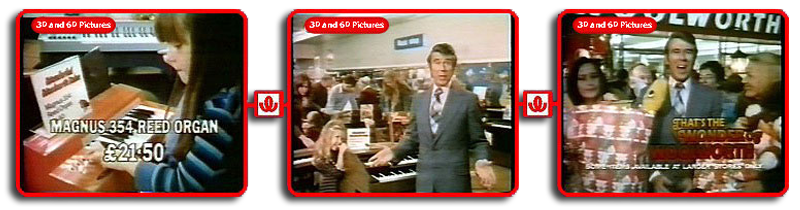
 

Legendary comedian Leslie Crowther hosted one of the first Wonder of Woolworth adverts for Magnus Organs in 1975.  At the keyboard is Nicola Greenwood, a young customer


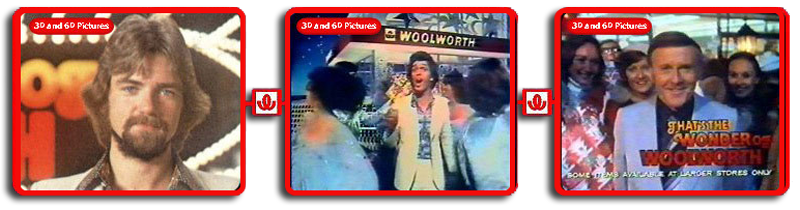
Many celebrities featured in the Wonder of Woolworth advertising, but none could beat the virtuouso performances of a very young Noel Edmunds (left) Georgie Fame (centre) and Sir Jimmy Young (right)


The commercials varied in length from 30 seconds to the whole ad break. They regularly featured a galaxy of stars. Georgie Fame and Sir Jimmy Young both did two or three minute slots to camera.  Over the years there were lots of walk-on cameo appearances, from both stars and personalities in the news.  See how many people you can recognise from walk of fame, which spans the years 1977 to 2007.
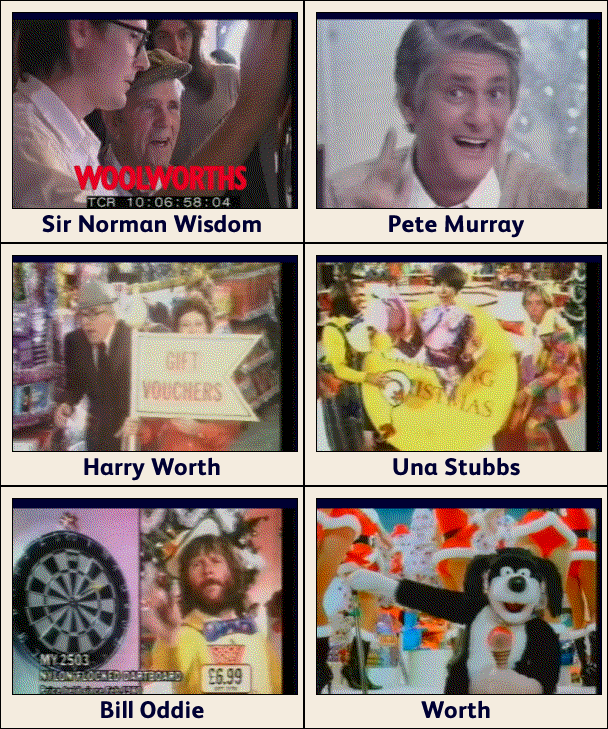
 

Walk of the stars - some of the top flight personalities who have starred in Woolworths tv commercials over the years


A Worthing customer adjusted the sign just inside their local Woolworth store. The staff agreed with the sentiment and left the defaced sign on display until the firm finally improved their lighting.


Among the favourite TV campaigns of the era was Sir Harry Secombe's "Everybody Needs Woolworth" from 1979.  It featured spoof pantomime sequences in which Harry (Aladdin) sang the names of as many products as possible in a commercial of up to three minutes' duration. At the end ("look behind you") a parcel fell from the sky and swallowed the rumbustuous former Goon. It finished with a muffled "it ain't half dark in here, where's my lamp?".

Customers at the Worthing, West Sussex, Woolworth store, (which at the time was famed for its poor lighting,) had been asking "where's my lamp?" for years. One of them adapted the sign at the front of the store!
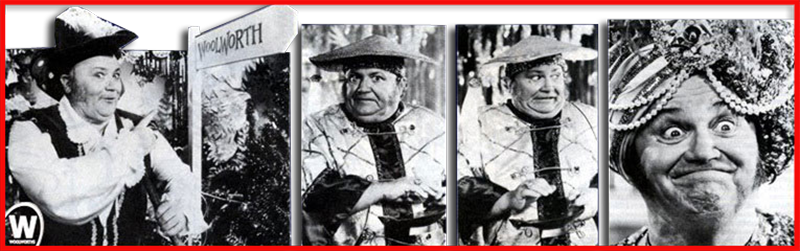
 

Sir Harry Secombe starring in the "Everybody Needs Woolworth" television campaign at Christmas 1979.  Like the best pantomime, some people loved it and some people shouted "Oh no they don't", much to the annoyance of company bosses.


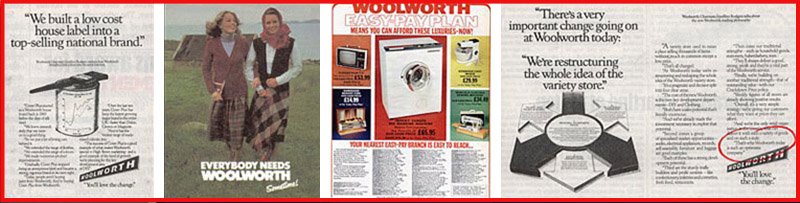
Alongside the salvo on television, the firm continued its banner print campaign. Some spreads featured specific products and promotions, while others concentrated on the brand. In 1980 the focus turned from shoppers to target investors and City analysts.


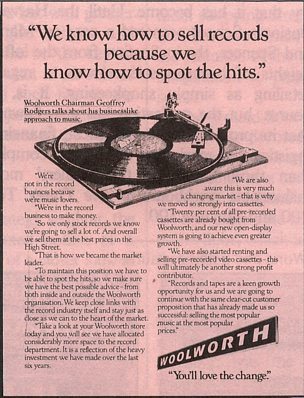
Woolworth became a big press advertiser during the 1970s, with a mixture of brand, product and corporate advertising - much of it linked to campaigns on ITV.


From a series of corporate advertisements pitched at investors that Woolworth placed in The Times and Financial Times in 1981.  It is thought that they helped attract predators to the business.


As part of the new corporate advertising Woolworth invested £100k to place a series of full page advertisements in the London Times and the Financial Times in 1981. The objective was to respond to City page criticism of what they considered to be lacklustre profit performance. The adverts sought to communicate the Board's strategy to revitalise the business. The copy highlighted the progress Woolworth had made in establishing large shares in its chosen new markets. It also flagged untapped potential which the Board was working to realise.

Only months after the campaign ran, a potential bidder for the British subsidiary approached its US parent in secret. The campaign had intended to achieve the opposite results and keep the British Woolworth safe from predators.


If you have enjoyed our Virtual Museum website, why not check out our complete history of Woolworths in a 194 page, richly illustrated paperback book?  A Sixpenny Romance is just £10.99, with free delivery in our on-line shop.
The special DVD, the Wonder of Advertising, is now available in our on-line shop for £7.50 with free delivery. A fully illustrated 194 page history of Woolworths, or a selection of professionally authored DVDs in our on-line shop