The Woolworths Museum
The first five cent table

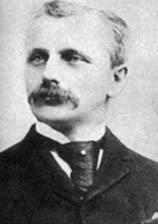
In Winter 1877 times in America were hard. The country was still recovering from the ravages of civil war, with weak infrastructure and much damage to repair. The population was expanding rapidly, but disposable income per head was falling. The shop where Frank Woolworth worked, Moore and Smith, was really feeling the pinch with a surplus of $35,000 of unsold stock.
Frank had spent a time away from Moores - first taking a job with A.A. Bushnell, a rival store, then recovering from illness on the farm. William Moore had missed him and his spectacular displays and had hired him back on the princely salary of $10 a week. But as times got hard he demanded that staff members accept pay cuts, asking Frank to settle for $8 a week. The reduction came at a bad time, as the Woolworths were expecting their first child.
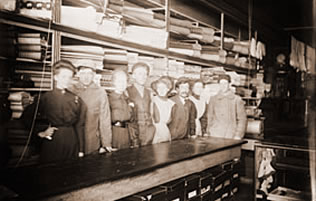
As fate would have it an old friend came calling at Moore and Smith. Mr. Golding had once been Head Clerk at Bushnells across Public Square, Watertown, before leaving with a co-worker, Ed. W. Barrett, to set up a "99¢ store" in Port Huron, Michigan. Frank listened in on the conversation.
William Moore admitted times were hard; Golding responded with news of his progress in Port Huron. He and Barrett had come across a salesman called Joseph C. Bennett, who had devised a novel way of clearing surplus handkerchieves from one of his suppliers. He had put the job-lot on sale at 5¢ each rather than 20¢. Every item sold out in no time!
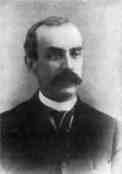 Moore was dubious until Golding revealed that the supplier was Spelman Bros. He enquired about the best method of display. Golding suggested using a table at the back of the store with a sign reading "Nothing on this table over 5¢". Bennetts' had majored on "Yankee Notions" with pots, pans, napkins and combs and had achieved a respectable cash margin despite the low ticket price.
The 99¢ men had set a rule that if an item gathered dust on their shelves its sales must be too low and it should go on their fixed-price table. Sales had rocketed, as shoppers turned all the surplus into cash, just in the nick of time to pay the month's bills and wages. They had asked Spelmans if they could supply more 5¢ bargains and had been impressed at the imaginative range they had put together.
Golding planted the idea and left Moore to consider it. Later that day he picked Frank's brains on the subject, and was impressed at how quickly the young man spotted the potential. Woolworth urged his boss to give it a go, saying "leave it me, I won't let you down". Moore duly placed a small opening order, after obtaining Golding's promise that more would be available quickly if Frank was right. He set his young apprentice to work, telling him it was a one-off chance to prove himself and only the best would do.
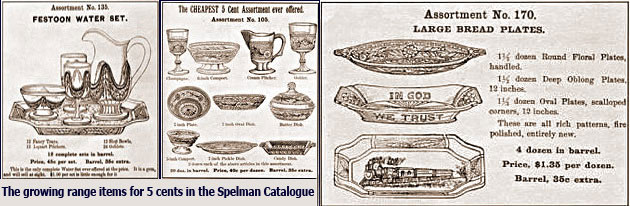 The next time Moore was in New York in August 1878, he ordered $100.00 worth of 5¢ lines.
Woolworth was put in charge of the table. It was displayed during the Watertown County Fair - a high point of the Jefferson County social calendar.
The goods arrived with a week to spare. Woolworth prepared a smart display, as Fred Kirby watched on. To supplement the special buys, Moore had extracted slow moving lines from around the store. To complete the display Frank prepared a neat cardboard sign, which he suspended from the ceiling. It read "Any article on this display 5¢".
The feature consisted of two old sewing tables butted together in the central aisle. Each measured about 1.75m by 0.6m. Woolworth had draped it in red cambric. The products included:
Crochet Needles
Button Hooks
Glassware
Watch Keys
Handkerchieves
Safety Pins
Collar Buttons
Pencils
Tin Pans
Wash Basins & Dippers
Writing Paper
Turkey-red Napkins
Thimbles
Envelopes
Soap
Harmonicas
 The 5 cent table was an instant hit, with word getting round town that the Moore and Smith store had exceptional bargains. This generated a steady stream of customers throughout the day. The assistants were rushed off their feet. By closing time the display was almost empty. Moore sent Frank running to the Western Union office above the store to telegram a repeat order from Spelmans. Woolworth later recalled: "The goods vanished like snow in April ... Immediately things began to happen. Like magic, the goods on the '5¢ counter' faded away and money flowed into the cash drawer."
After a while sales started to dwindle. Moore assumed that 5 cent merchandise worked better when offered from time to time, but Frank had another assessment. He observed that Spelman had filled the store's repeat orders with items of lesser quality. Over time the poor items had clogged the display. The proposed Woolworth remedy was to clear the remnants in the wholesale orders that the store had started to supply to other local merchants.
Sales rallied, but Moore harboured reservations about carrying a regular range of five cent lines. He feared that the bargain table might undermine the store's upmarket image. Frank understood the quandary and wondered whether a store could prosper just on the sale of five cent goods. He asked Moore for advice on how much stock would be needed to fit out a five-cent store. Moore believed that the idea had potential and estimated that $300 would be needed for stock, fixtures and advance rent.
Frank was undaunted by Moore's figure. He set his heart on giving the idea a go. He asked his most affluent relatives if they would bankroll a venture. His progress is described in our next feature.
Shortcuts to related content in the Woolworths Museum
1800s Gallery
Introducing the Woolworth brothers
Museum Navigation